

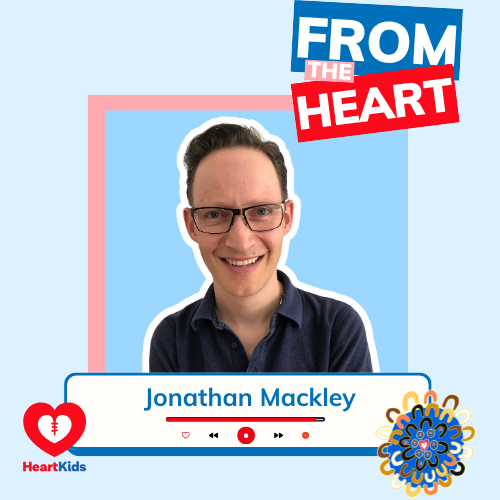
In this episode of From the Heart, Jonathan Mackley shares his journey from being born with a complex heart condition and undergoing one of the earliest Fontan surgeries, to becoming a strong voice in the HeartKids community.
Transcript:
Before we begin, we would like to acknowledge the traditional owners of the land of which we record. We pay our respects to elders past and present who are part of the world’s oldest continuing culture and the first storytellers. We acknowledge the importance of supporting health for all peoples now and in the future. Aboriginal and Torres Strait Islander people are warned this podcast may contain the voices and names of people who’ve passed.
Welcome to the HeartKids podcast. Join us to hear stories of Australians affected by childhood heart conditions. On this podcast, you’ll hear from heart kids and teens, heart adults, parents, carers and family members, cardiologists, and other health professionals. My name is Rachel Knowles and I’m one of your hosts. I’m a journalist and I live with a congenital heart condition. I was born with tricuspid artresia and had Fontan surgery at the age of two. I’m passionate about people and their stories and I’m excited to walk with you on this journey as we share experiences and learn more about those of us living with childhood heart conditions.
In this episode, we speak to Jonathan Mackley, a longtime advocate and co-founder of ANZFAC, the Australian and New Zealand Fontan community. Born in 1975 with a complex congenital heart condition, Jonathan underwent multiple surgeries before the age of six. Turning 50 this year, he shares what it means to live with a Fontan circulation as an adult and how that experience has shaped his life, his work, and his advocacy.
J: You never know what conversations are going to spark something for somebody else or give somebody an aha moment or give somebody just the encouragement to press on with their own journey. Or when you might get the encouragement yourself that you didn’t even sometimes realize you needed and you hear a different perspective, you’re like, why aren’t I adapting them? That’s fantastic.
R: Welcome to From the Heart. We’re really excited to have you here. Thank you for joining us. Where are you dialing in from?
J: I’m dialing in from Naarm or Melbourne, the land of the Wurundjeri people as the traditional owners.
R: Beautiful. How is the weather in Melbourne? It’s been miserable here, but I’m hoping Melbourne’s been happier.
J: It’s been all right. It’s you know, four seasons. Uh it’s definitely cooler in the mornings, but you know, longer days are starting to feel like spring is coming. That’s really good.
R: That’s nice. That’s exciting. Melbourne has a beautiful spring. I’m very jealous. I’m very jealous. So, I guess the question that we like to ask everybody is what is your heart condition and when were you diagnosed?
J: Sure. Thank you. Uh so, I was uh diagnosed very young. Um I was born as a blue baby. Mum describes me as a you were a cold baby and within the first few hours of being born, it was clear that I was I was not well and over that first 24 hours I was transferred from Mornington Bush Hospital as it was back in the day to Royal Children’s Hospital in Parkville Melbourne. Mum and dad traveled up and were there when I got there. Um, and I was originally diagnosed with, at the Royal Children’s with a double inlet left ventricle, pulmonary stenosis, and a hypoplastic right ventricle. So, collectively referred to as a pretty severe congenital heart disease.
R: Yeah, that’s massive. That’s I was like, that’s quite the that’s quite the mouthful.
J: Yes. Yes. I never explain it like that. I just say, yeah, you know, half a heart is what I function with and I do as best I can with it.
R: Yeah. Beautiful. Well, tell me a little bit about I suppose growing up in the in the 70s and 80s and what you remember of growing up with a heart condition and what it was like.
J: Yeah, sure. I think my earliest memories are actually sort of in the in the hospital scene. So my first operation was a Blalock-Taussig shunt when I was two and a half and at 5 and a half I had the Fontan AP operation or archer pulmonary operation which is the original generation and I remember waking up in the hospital with something large and cold next to me which I later worked out was an oxygen tank, but life for me sort of in my mind sort of started from there. I don’t recall anything before I was five, which is common. In primary school, I was not really a fit person and so I remember struggling with running or any of those kind of sporting activities, but I was always involved. My parents did not cottonwool me and I’m really grateful for that. They were determined that I would enjoy as much of life as I could and be treated as normal. So, I didn’t really see myself as having a heart condition. I just wasn’t aware of it as such. I just knew I needed to take breaks occasionally, but I didn’t really understand what it was until much later. So, yeah, I did all the normal things that you would do. I learned to roller skate in the street and would play basketball as I got into high school and did swimming and swam at uh school holidays. Went to the beach wherever possible and yeah so as far as I knew it was a little limited in some sporting elements but other than that it was a pretty good childhood.
R: A happy childhood. I’m really interested. So you mentioned being transported to hospital. So you had quite a few surgeries in your early life. What was it like? So did you have to travel for those surgeries? What was it like for your family and getting that kind of health care for you?
J: Yeah, look, as I mentioned, I was born in Mornington which was regional Melbourne at the time and we traveled up to Melbourne which would have been about an hour and a bit drive to the Royal Children’s Hospital. I do recall growing up mostly inner Melbourne. So I know my parents moved up to Melbourne. Um, they had multiple reasons for that. My dad was studying in the city and there were more jobs up there and they decided to move off my grandparents farm and start their own life with a young family. I’m the second of three kids and so it was always in and around Melbourne. So, we were in reasonable proximity to hospitals and those sort of services.
R: I can imagine I suppose for you and we’ll go into this later, but you do a lot of advocacy work but I suppose comparative you know looking at generations that come through now is that kind of crazy to you the difference that there is in I suppose care and opportunity in this space.
J: Yeah definitely. I think it’s amazing. I mean HeartKids as an organisation for example you know kicked off really in the 80s in Victoria. So when I asked, when I first found out about HeartKids and asked my mum about it, she’s like, “Well, that wasn’t even around and those services weren’t available.” So I know it was very tough for my parents in a lot of ways. My mum still reflects on the fact that she felt that the hospital systems pretty much said, “Take him home and enjoy him.” And the cold hard facts were that I wasn’t expected to last more than a few weeks. So they sort of went home with that shock horror and I know my dad’s not a fan of hospitals. So I’m sure that has something to do with it. So I think it was very stressful for them. When I have talked with them about what do they recollect, they recollect being around for the major operations and taking me in and meeting the surgeons and getting the pretty cold hard facts around, you know, the risks and the fact is, you know, survival wasn’t high back then. And I reflected I was very lucky that, I think it was Dr. Roger Mee did my major Fontan operation and back then survival rates were quite low and in fact I recall hearing since then that teams from around the country certainly from Sydney and Canberra were sent down to oversee what was going on because they believed he was falsifying his survival numbers, because he had revolutionised the way he was approaching the operation from an end-to-end perspective clinically. So, you know, so there’s that’s the silver lining. But, you know, from a support structure or a community support, my family really only had their neighbors, their friends, and they relied also on the church for a lot of support. So, there just wasn’t much else. And I remember growing up not knowing anyone else with a heart condition. My perspective was I’d had a hole in the heart when I was little and it had gone away. But I later on in life when I started to search for answers, there really wasn’t anything much around.
R: I was going to ask you because I think that that’s a really monumental moment, growing old enough to hear those stories from your parents and realise the gravity of your life and kind of those early days for them. What was, I suppose, what was those moments like for you sitting down hearing those stories and really sitting with them and realising your journey and your health?
J: I think I wasn’t really aware until I was much older and by then I was, you know, in the adult hospitals field. I certainly didn’t transition from pediatric to adult. Partly that was my fault, partly that was the circumstances and the lack of really structure around that process. I had Dr. Brian Eades at the Royal Children’s Hospital, lovely man. I met him probably 5 years, 5-10 years ago and I was just delighted to see he’s still alive going and just as I remembered him. But I have asked my mum about that since and she said, “Well, you were, there were a few appointments set up.” Unfortunately, my folks had split and I was not in a place where I really wanted to care about it. I was quite happy to say no that was a thing of the past and I don’t have an issue so you know why do I need to bother with all this stuff. When I reflect back on it, yeah, I think what is in place now is fantastic from educational resources and whilst a lot of people do find irksome sometimes the social media world, it does offer a great deal of support and information that’s now at your fingertips, which for most people is accessible – for a lot of people anyway – but there’s still gaps and I think that’s, but it is still amazing that I can, you have conversations with people overseas through those channels, for example, and having spoken to somebody else of similar age to myself in the US and compare notes around what do they have and what you know. We’re pretty, if you’re in a suburban region or metropolitan region in Australia or even some of the remote areas, it’s still a lot better than a lot of other countries. So, I guess it’s relative, but it really just matters what you can access. And when I speak to different people, it’s a disparate experience across Australia and New Zealand for sure.
R: Yeah. Yeah. It’s a really interesting community to be a part of and to work within. I am really interested – I suppose of your journey to HeartKids and how you kind of began, I suppose touching base with community and meeting people who were, who did have general heart disease.
J: Yeah, that’s a – it’s a good question. It’s a good story. I was doing my masters in 2013, 2014 in communications and one of the major projects was we had to do something that had a personal take and I remember drawing up a Venn diagram that said, well what’s something that I can do that relates to me personally being born with you know a heart disease and, you know, looking at how can I give back from the skills that I have, something that would help me professionally from a change in communication space which is my work, my work life and something into the nonprofit space, as well as something that you know might improve my capability of communicating with people. I didn’t take long until I thought, you know, came across HeartKids when I did a bit of research and I had heard of them before and I thought, yeah worth giving them a call and I think it was Lynette that I spoke to at the time and I caught up thinking, “Oh, this this would be really good. I’m really excited.” And I offered, I’m doing my masters, I’m interested in doing some marketing and communications work in the not for profit space. And the general response was ‘we kind of have that resource centrally and it comes out of Sydney and thanks very much’ until I thought I really should mention something rather unique to me which is that you know I’m heart adult and of course that changed the conversation dramatically. And it was ‘wow what that changes a lot, well you know let me come back to you’ and it wasn’t long after that I had a call from the late Norm Hutton who was the CEO at HeartKids at the time. Lovely man, had some coffee catch ups with him and long story short, got heavily involved in HeartKids on a number of fronts.
R: I know that you eventually made onto made it onto the board in Victoria as a member of the board for HeartKids there. I think something that I think about frequently in our community is, you know, sharing our stories and being out there is one aspect of advocacy, but another is actually looking at being part of organisations and institutions and doing advocacy work within systems. For you, I suppose was this your first instance of being on a board? How did you kind of find yourself in this world? What did that feel like?
J: Yeah. Yeah, it was, it was very exciting. I think because it happened fairly quickly. I remember it was in the August that year that Norm raised the question of would I be interested in joining the board and I was like sounds amazing, what does that involve? I didn’t even have an awareness. I was 40 at the time and it wasn’t common for people so young to be on the board and a few months later I was on the board and it was it was a good blend of really that sort of personal and professional development, because it gave me the opportunity to really tell my story. You know, there was obviously opportunities through HeartKids to be involved in some fundraising activities. I did some business lunches which was called Off The Cuff back then and I was keynote speaker at a Saturday Night Fever event as well which Norman said I would be a speaker at and I remember turning up at the event and my name was listed next to the menu as the keynote speaker. I’m like, “Oh, might have to adjust my notes here like this.” But it was very exciting. But yeah, it was a great opportunity for personal growth as well and starting to think about well if I’m going to be somebody who stands up and talks about my story, I also need to talk about what helps and you know not just what I’ve experienced but what have I done about it and what helps and really got me thinking about what can I do in this space and it really was a stepping stone for me to do other things particularly involved in the Australian New Zealand Fontan Community, which in 2014, it was a busy couple of years actually and I think we had not long started our family. So it was a busy time on the home front and the work front as well as my extracurricular activities. And so in 2014 my wife Nori heard on the on ABC radio that there was a Fontan registry and which it meant that they were creating a database for and interested in collecting information from people who had had this Fontan operation which is where you take the circulation of the heart that isn’t working for whatever reason and you’re reshaping the heart to work with one ventricle, a single ventricle system and which is my case and the case of many around the world, in Australia and New Zealand of course, and so we went along to an education day. Long story short and it was just amazing to hear about my heart condition so explicitly and with such clear information and hear what they’re doing on the research front and from that education day that was being run there was a call out to who would like to be part of the feedback loop with the community and be a sounding board and assist the research teams with understanding what the community needs what do, what would they benefit from the most. So that was sort of the kickoff really of what is now the organisation or subcommittee of HeartKids which is a community and volunteer-driven group called ANZFAC which we call it that for short which stands for Australian and New Zealand Fontan Community.
R: Beautiful. Well, coming off the back of that, I think when we talk about advocacy, I think that a lot of the best advocacy comes from connections to grassroots for you, particularly in ANZFAC and those early days of kind of finding that the role of that body and connecting in with community. Is that something that you really felt was important having that grassroots connection, having community have a space to come to?
J: Definitely. So I think for me it started with HeartKids when I was a community coordinator in the inner west of Melbourne when I first got in contact with HeartKids. That was one of the other activities I got involved in. And that really struck me as how powerful it was to meet people who had the same condition. And I hadn’t before and I hadn’t known other people who were dealing with severe complex heart conditions. But I’d often wondered and but you know it’s not uncommon that most people thought I, you know, I figured we were a rare breed but we we’re not. There’s actually a lot of us and we’re surviving more and more which is fantastic, as a result of medical interventions and community support as well. So that initial connection that I made through meeting other families around a barbecue or a picnic, whatever we were doing each month for a couple of years really got me thirsty to go, well, who else is in my age group? Because most of the people I was connecting with had toddlers or babies or young kids.
So I think one of the things that really stood out to me was that I didn’t know anyone else in my age group. And so that thirst started to build and when I went to the Fontan education day in 2014 and met other adults my age, I was like, “Wow, this is amazing.” And it was such a rewarding experience to just make that connection and go, “Oh, I’m not the only person.” And oh, we have a similar experience. And I was very keen to continue those engagements and conversations as much as possible. And I think that’s never gone away. It’s one of those things that just doesn’t change as much, and continues to surprise me that I’m always keen to meet somebody else. And it has got to the point where my cardiologist will say, “Hey, I’m interested in in connecting somebody, would you be comfortable? Uh, would you like to be contacted?” And I’m always like, “Yes, absolutely. Please, more of this.”
This is this is what, you know, this community needs and this is what as individuals we need is that that affirmation that connection and knowing that we’re not alone, but that there are others with a shared experience. And it’s just so powerful to hear somebody else’s story and hear commonalities, but sometimes also differences around your experience. And just talking about the variations sometimes in advice or thoughts or approaches that you might have formed or you might be taking. And I think my desire to stay involved in ANZFAC which has been over 10 years now, and to stay with it is primarily for those factors, that I know the power of sharing my story. I know the power of connecting with other people who have got a similar experience or who are caring for somebody with a similar experience. The number of parents when I was working with HeartKids that would come up and go, it’s just so wonderful to see somebody who’s gone on to do the things you’ve done or to be living well um at your uh age. So, it’s I know that sometimes even just being there even if you’re not trying to say anything, you’re just there to connect with people can be really powerful.
And the other element that drives me is that looking at what wasn’t there when I was younger and going ‘what are the gaps that still need to be addressed’ and whilst there’s a whole lot of educational resources available now I, you know, I’m still always looking for what else can we do in this space. I know for example that as I get older what I’m facing into and the health challenges I’m facing into and the mental health challenges that I face into some of them are the same whether I was 20 or 50 whereas some of them are new and whilst there is a shared amount of knowledge out in the medical fraternity or through consumer products on different websites it’s about helping people find them, which is, you know, a lot of what I do in my role too is if people want to go from A to B or get an answer, how do you help them find that and contextualize that information for them?
I’m not an expert so I don’t give out medical advice of course but how can I say ‘well this is what I found helpful’ or ‘this is where you might find some more answers around those kind of questions’ or ‘did you know you don’t actually have to do all AB and C’ and you know you can ask different questions and you can demand different opinions or delay your decisions around this in some in some scenarios. So it’s really about helping people understand the power of choice that they have and to encourage people to get the information that might be available or to demand that information or answers or better explanation so that they feel like they’re making a more informed decision because so much of living with a chronic health condition, and it doesn’t matter what that condition is, one commonality that I hear back across my lifetime is that people do feel a sense of lack of choice and that they are subject to this condition and in part that that is true. We can’t necessarily change the past or change our scenario in some ways, but in other ways we can.
R: I think that’s a yeah, it’s massive and I have something that I want to ask you about that, but I just want to go back to ANZFAC really quickly because you know, as someone who’s engaged to ANZFAC, I have um you know, you’re an original Fontan generation. I’m a Fontan. So the work that you have done and the structure that you’ve built, you know even in advocating for myself in medical structures like I’ve come to ANSFAC and I’ve come to particular members of ANZFAC for advice and information on how to better do that. So as much as yeah there’s that community there, there’s also so much knowledge in that group where you know when I’m faced with a situation I don’t know I feel out of my depths about there are people who have done it before and even if they haven’t done it before they can help guide me through it which I think is a massive thing and it’s really like completely changed the way that I’ve been able to interact and advocate for myself and demand answers and have an empowerment around the choices in my health which is massive. So, thank you.
J: Oh, you’re welcome. I’m really glad to hear that. And that is you know, a number of times across the last 10 or 11 years we’ve been going. There have been challenges to will we keep going? You know, do we have the right organisation structure or backing and who are we partnering with? You know, when we first kicked off, we were connected with the Fontan Registry and associated with that and that was really a natural birthplace, if you like, for us as an organisation, a community-driven organisation. And as we evolved and moved from our purpose being about offering people connection and community, it’s like okay, how can we empower people and provide educational resources and so finding HeartKids and doing more with HeartKids, which is something that I was involved with along the way. So, you know, Tracy Stanley, who’s been involved with our group from the from the get-go as a support manager in the community, you know, I knew she knew that same value and a number of us really whenever we asked our questions like, “Do we keep going?” You know, it’s it always comes back to that you never know what conversations are going to spark something for somebody else or give somebody an aha moment or give somebody just the encouragement to press on with their own journey or when you might get the encouragement yourself that you didn’t even sometimes realise you needed and you hear a different perspective, you’re like, why aren’t I adapting that? That’s fantastic.
And so for me, as long as I can, I would like to support these opportunities for community voices to be heard, but also a place for community to come together. I know when we started there was a bit in the UK on social media, there was a bit in the US and it’s quite disparate and we’ve grown to a fairly organised process and a way we go about things but it always comes back to we exist so that people have a way to have connections and when we say ‘look we’ve only got a few volunteers this year, what are we going to do’ it’s like, well the most important thing we do is we get along to Fontan Education Day and represent that there is that feedback loop and guide the Fontan Education Day which we have been doing for the last eight or nine years now where we’ve had a seat at the table to say well that’s great that you want to present this research or it’s great that you want to bring up this topic but please make sure you include the lived experience perspective otherwise it could be quite scary or you’re only giving a medical perspective rather than, you know it’s much better to pair that together with the lived experience so that people can understand how it applies but also understand how it anchors that they have a role to play and I think that has sort of led more to the research work I’ve been involved in too which has inspired me to say well answer that question what would help more and what does a really good engagement or experience look like yeah I think that’s a massive thing as well you know when you mentioning gaps before you know people who know what the gaps are of the people who have fallen through them.
Yeah. That’s the way that I always think about lived experience is that if you want to make something, you know, like solid and have that foundation, you need people who have not had that to show you where the blind spots are.
R: I’m really interested in like your research work and kind of the topics that you’ve focused on and how you know you’ve talked about that feedback loop, how you’ve kind of built in accountability into research and clinical work for people.
J: Sure. I think that was there were about I think there were about 10 of us when we first in the first year that ANZFAC kicked off in September … it was 20- I’m going to get the date wrong. I think it was 2014. And off the back of that initial or inaugural education day and the the thing we focused on first was just because we are a handful of parents and carers and people living with this particular heart condition and this Fontan circulation. How do we know that we’re actually going to do a decent job of representing? And at the same time we had the Fontan Registry saying what is it you think the community needs at this time and are there any areas you would think that needs a bit more focus. So our first project really was to build a survey. So in that first year and a half really we were setting up our terms of reference and identifying what it is we wanted to stand for and how we wanted to operate, organise ourselves but also in setting up our own cadence around how often would we meet, what would we talk about and what would be the structure of our conversations if any.
And sometimes there’s not because it just becomes apparent that we need to connect if we’ve all had a busy period of time. But the other thing, the other project we started on really was creating a survey and worked with the Fontan registry to ask the questions about what is it you’re most worried about? What is it you’re most interested in knowing more about, and those kind of things and that that led to a great survey being released with quite a reasonable response rate. It was released online and as well as to people who were in the Fontan registry on their database already. And it was that sort of birthed, it was a strong input into a research paper that was put out which was literally called ‘How long will I continue to be normal?’ which was, you know, the most fundamental question that was being asked by the community. So it made sense that we focused on that and the main things that people were most worried about was literally that question how long will I remain normal? What is in front of me? And you know that then led on to really looking at what is the quality of life for people with congenital heart disease or CoHD as well and looking at a blend of support and knowledge and self-perception which was another paper that I ended up contributing to as well.
The most recent thing I was involved in and was really developed through COVID was a paper which was really focused on the interaction between clinicians and patients and focusing on what could that look like and what does what does really good look like? So that was started out of a question that my cardiologist asked me. He had been away and I had a stand in cardiologist. I’ve been seeing the same cardiologist since I was 22. I count myself very lucky for that given that I’m turning 50 this year and very blessed to have Professor Sam Menahem as my cardiologist. And he’s done an amazing job in guiding me and he was away overseas. He still travels quite a lot for different research and things like that. And I had a stand in cardiologist who it wasn’t a great experience actually. They asked me some general questions and I believe skimmed my file or so they told me and said you know and started asking me questions. You get on a lot of surveys particularly when you’re administered to hospital which a lot of your listeners might be familiar with such as you know how much alcohol do you drink and um those kind of things. I’m always very honest and I’ll have a couple of drinks each week and these days that is I think I was probably drinking you know, one you know a glass a night at that time and this clinician berated me and said do you have no idea what the link is between alcohol consumption and arrhythmia and I said well no please tell me and they began to quote a particular paper and cited the references of that paper to me and I was a bit taken aback and I was like, well, I that’s great to know. Okay, fine. And I remember leaving that conversation feeling really pissed off and thinking that’s really unfair.
Like, how would they know my experience and how would they know what knowledge I have and how would they know why would I be reading published papers? How is that information going to get to me? Often they’re locked behind a pay wall anyway. And uh so I debriefed my cardiologist on this, Sam and he said, “Well, that’s really interesting. Sorry about that. What do you think would help?” And I said, “Well, that’s a good question.” He said, “No, seriously, have a think about it. I’d like to pair you up with a student that they were supervising, a medical doctor who was looking at potentially moving into towards cardiology. Would I be interested in having a few conversations with them and together we can look at this holistically and I said sure why not, so we ended up spending it was myself and now Dr. Aleksandra Lange and she and I talked for about 12 months during COVID which you know you didn’t have many other options anyway to socialise so it was quite cathartic for me but talked about you know what would help and we talked about what from her perspective what she understood was being taught of doctors as far as focusing on the patient experience versus all the process and diagnosis and other toolkit that they learn and I talked about my experiences and what I felt would be helpful and together we ended up pulling together a paper that really was, is titled ‘How can clinicians improve their experience and that of their adult congenital heart patients?’ and it really just boiled down to four things.
It was about establishing a common ground. So understanding what’s the language and knowledge of the health condition and what are the goals. Number two really is exploring together what would the be the good outcomes and what are they dealing with and sort of helping unpack that. And the third one being making communication transparent and in really informative things like you often get referred to somebody and you often well I found through a lot of my life I’d be handed an envelope with somebody’s name on it and they’d go and here’s the phone number and the reception would give you the phone number and say you call this person and make an appointment and they’re your specialist and you’d be like that’s great. I have no idea what you’ve told them. I have no idea exactly what I’m going to them for or what this might involve. Whereas uh through the work on this on this piece, uh now Sam, my cardiologist, always copies me in. I get an email that’s the same email every time I get referred to or he gives an update on my health condition when I’ve seen him. He writes to my GP and I get a copy of it. And it’s just really empowering to get that information and go right I’m much more familiar with the language being used and I can ask him the questions around why did you say that? What does that mean? And really the fourth one is what I see my cardiologist doing now and I’m seeing it more happen more and more is that to actively support community connection. So, I know there’s this tension where from a privacy perspective, obviously you wouldn’t want your cardiologist or your specialists handing your name out and your phone number out to anyone, but they could ask you and they could say, look, you know, if they’re dealing with somebody who is expressing that they are feeling quite alone with this and they would really like to talk to somebody, they could share that, you know, there are organizations that exist like ANZFAC and HeartKids as well as maybe offer that they could put them in contact with somebody if both parties were agreeable through that.
You know, in this day and age, I don’t think that’s a hard ask.
R: I think that’s a – I love what you’ve said about like, you know, being copied in on information and having that language, but again, it comes down to that’s your choice. That’s how much information you would like to know. A patient might not want that amount of information. And they might want it handled but at the end of the day that’s a decision that you have made that you have had respected by your healthcare team. I suppose you know we talk a lot about the concept of lived experience. I do a lot of advocacy in like the justice and the social services space and constantly asked about lived experience and how it can be better implemented and how we can work with people and I feel like sometimes the health care system is a little bit behind with this kind of stuff when it comes to healthcare when it comes to those as you said you know the feedback loop and the relationship between clinician and patient what is, the what’s the value of actually collecting lived experiencing and using the learnings of that to better the healthcare system. What what’s the value of experience in this system for patients and for doctors?
J: It’s a great question. I think for patients as I’ve experienced, hearing somebody else as they’ve experienced can be quite assuring. It can also be upsetting. So, it can be a double-edged sword in that way. And to your point, not everyone wants to know the same level of information. Not everyone wants to engage with the terminology or the system in the same way. And even for somebody who’s really, since my early 20s stepped into it and owned it and embraced it, there are definitely times where I don’t want to know. I want to tune off it and I don’t always spend a lot of time on social media for that reason. But there is definitely having that available to you when you want to dip into it, having those support networks when you want to ask the questions like you mentioned earlier. Sometimes I’ll have something happen or somebody will say, you know, I’ll get a piece of information around my condition or a test that I haven’t had before and I’m like, what’s that? And I’ll ask Dr. Google and get some idea or these days chatGPT and get a bit of an idea around what it might mean and it might be in slightly better layman terms but not always but it doesn’t answer, well what will that mean for me and what does that mean if I go ahead with that experience? So having somebody that you can talk to and I think from a clinician experience the feedback I’ve got is it’s really invaluable to hear the broad spectrum of the community voice because there are people who want to hear about the hard stuff. There are people who don’t and you know it was whereas I was involved in a conversation this week where we were talking about that exactly and we were looking at what kind of presentations might we want to see come out in the next 12 months and the topic was raised around heart transplant and there was a lot of tension in the conversation which was a conversation had with clinicians and community people and it was a mixture of we don’t really want to scare people. We really want to in some forums talk about that it’s not appropriate because the general audience might be a young group or people might not be coming expecting to hear about that stuff.
Whereas there was also other voices within the group including my own that said where do we go to for this information? Like there isn’t if we’re not talking about it who is like and that’s sometimes part of the role of giving that feedback is to go okay not every forum is suitable for talking about those kind of things. So what forum can we design or set up or establish so that we can enable that information to be shared and consumed at different age appropriate levels but also create a space for a conversation to be had for those people who would like to have that conversation or who are exploring that conversation. And you can’t have those conversations and leave people in the dark. So where would we find a trustworthy source for that information? And which experts could we bring in to that. So it’s often a coordinating role that I find myself in as an advocate for the community and a number of times it’s well I know this is a gap and if I want to have a shared voice in that space and ensure that information is presented in a holistic perspective such as a clinician talking about it with the context of the heart condition that I’m dealing with as well as a lived experience, then I need to bring them together and ensure that that is represented. And I’ve been involved in doing that a couple of times and it’s always with mixed feedback because not everyone was looking for that piece of information, but I know that if that information is out there and has been recorded or documented in some way, then when somebody else is asking those questions, then it might be available.
R: Yeah. And I think that’s the thing is it where it’s like people, you know, people will come to that if they need that and it’s better to have said it than to not have said it. Because this information as we know has been gatekept a lot of the times and we don’t I didn’t study cardiology. I haven’t got the faintest clue about any of it. So like it’s nice to be able to go to places and be like ah this is a reputable source. I can read this and feel comfortable. I really I don’t want to understate the contributions that you have made to the community and particularly you know the Fontan community and I think I’m really interested in your in your advocacy career what what’s a like a proud moment for you where you realize that the work that you’ve done has contributed to change or has contributed to a positive in somebody’s journey. Has there been a moment that you kind of do hold on to?
J: Yeah, there’s a couple that stand out. I remember somebody was, I was contacted I think it was through my cardiologist. I could be wrong. I might not remembering the detail but the scenario was that there was a father of a teenager who was around 17 who was interstate and was being recommended to have a liver biopsy and the liver is downstream of the heart so it’s sometimes considered as something worth observing and monitoring these days which is good and important to do so. And they wanted to really understand what’s the patient experience around that and long story short I had a phone call with them and the parent was saying well they’ve been written up as this is and being they’re being booked in we don’t feel like we had a chance to speak about that you know I really encourage you to press back and say, “We’re not quite ready for this. Doesn’t mean we won’t do it, but we’d like to explore all the other options first.”
And for me, that was an important moment because it gave somebody empowerment. It gave somebody choice. And I knew that was something I’d been able to contribute to. So, that was really great. And I think also it’s two-way when I think of proud moments. It’s too that more recently I was able to call somebody else up and really leverage that. You know, I’m not somebody who’s without doubt or concern or mental health challenges when I faced with my own mortality or changes in my circumstance. So, when I got asked to do a raft of tests in recent months, you know, I thought, what would I encourage somebody else to do? I’d encourage them to pick up the phone and reach out. So I was really grateful that somebody who I’ve been working with in ANZFAC for quite some time who’s also become a very good friend that I could reach out to them and say having a tough week, let me know if you’ve got a chance for a chat and it just made a world of difference for me.
R: Yeah, yeah it does. It really really does to be able to just debrief with someone who’s like, “Yep, I’ve got you. This is hard. These are your options. This is what we can do.” And I think there is when you have been a patient in the healthcare system for a long time, there is an inherent power dynamic that you feel with clinicians. So to have a community around you that gives you other options, that allows you to say no, you can question this. You can ask questions around this. You don’t have to agree and go with it, is a very liberating thing.
J: Yeah, I totally agree.
R: I understand that you have a quite a significant birthday coming up. Congratulations.
J: Thank you. The big 5-0.
R: How are you feeling?
J: Pretty excited about it, actually. It’s at times like this you do sort of reflect on your story and your journey and uh whilst life is not without its challenges as anyone finds and my medical condition is evolving as most people with a chronic health condition do find, you know it doesn’t take much to realize that from where I began and was given only a few weeks to live but through an amazing amount of support and miracles of what they can do in in the medical world as well as, would have only survived other stages of my life but for uh friends and family. It’s a poignant moment to reflect and go yeah I’m really pleased and proud of what I’m doing and then it’s also an opportunity to go okay so what else will I do and what do I want to continue to do in this space but also you what can I do is the question I continue to ask myself. Excited at this stage not to be slowing down. I’m not planning to put the cue in the rack and put my feet up and retire, still working full time. I have two beautiful girls, a teenager and one in primary school and happily involved with the family. I think that’s probably something that is, you know, part of this life stage is you tend to go, well, I want to do all these other things, but I want to be here for my girls and um enjoy this time with my wife and take the rare opportunities we get to spend with each other and with family. So, I think it’s always you always got to adjust and find that that balance. Yeah, it’s exciting.
R: I think it’s a um I remember my grandpa saying something to me once about, you know, it’s a it’s a blessing to live a life on borrowed time. And you do appreciate kind of every minute of it. I’m really I suppose moving forward, you know, how is your health now and are there challenges or concerns that you have on the horizon for your health? I know it’s a really heavy question to ask.
J: Yeah. No, it’s that’s a fair question. And it’s one question I’ve never shied away from. My health condition now is reasonably stable and I’ve enjoyed a period of stability. I do see a cardiologist as I mentioned and will continue to do so. But in the last probably eight or nine years I started seeing a transplant cardiologist. So that’s something that is being monitored so that we can look at um you know the options when you have got a Fontan circulation you know it’s sadly not a cure. It was designed as a palliative solution. And that’s a really fancy way of saying it’s a stop-p measure or a band-aid. A very good band-aid for me having reached 50. But reality is I’m a pioneer. I’m not the only one. I’m not Lance Armstrong. I’m not the first person in this space at all and not by a long shot. But I have had conversations with other clinicians who have said, “Well, you know, you’re a pioneer in this space, so we don’t know.” And sometimes that can be very confronting. But my health, you know, touch wood is going fairly well. I do tire. I do, it’s strange. I will tire from walking but not so much um from swimming where I can swim at the moment. So I try and do that once a week and it’s only for half now. This week was a little bit longer, which was pleasing. Sometimes I have the energy and I’m like, “Yeah, come on. What do you got?” Uh, throw yourself at it. There are lifeguards nearby and I’m wearing a thing on my watch that says, you know, if you find me floating, this is the number to call.
It’s, you know, I say lighthearted, but I, I know it’s that I live in that space now where it’s trying to find that tension between listening to my body, but not being defined by it. So, that’s probably the an interesting challenge because it changes day by day. And there will be times where my wife or my family might say, “You’re okay? You seem a bit tired.” And there’ll be times where I’ll catch myself and go, “Yeah, no, I don’t think I have it in the tank today.” And so you have to prioritize. And I manage my condition well. You know, I work full-time and it’s an awkward one sometimes to bring up in the in the workplace. Um, and that’s something that that I navigate carefully, but I I’m also realistic that, you know, at this stage, the next intervention is will likely be a major one. But I’m also very grateful that I have a medical team that I can discuss it with quite openly. And one of the benefits for people who might be sitting on the fence who have decided I don’t want to know more about it. One of the benefits of stepping in and learning some of the language and asking the questions like can you explain that to me? Can you tell me why I’m having this medication? One of the benefits of embracing the information is I’ve found that I have been able to have conversations and question and have more confidence to question specialists and ask them those questions. Well, well, what’s next? And well, what are we going to do about that? Well, surely there are other options. You know, I’ve seen this or that on the internet. So, when are they coming to Australia? Or when is that available here?
Or, you know, even more recently, I’ve transitioned from coming off Warfarin onto another blood thinner, which I don’t have to have as many tests for. And that was only through me asking that question a number of times and saying, “Do I really need to be on this?” Because kind of getting sick of giving blood and it there are alternatives and I got a self test machine for a while and that was that was great. But I thought ultimately it would be great if I could manage this differently. So, I think it’s you know, I wear stockings to compress my legs to help offset any peripheral edema, some swelling that comes with a heart condition that is not quite as optimized as it once was. And I, you know, I choose my words carefully even when I talk to myself about that. You know it’s something that I manage and it’s challenging at times but I feel very blessed that at this stage it’s going okay.
R: Yeah that’s, I’m very very glad to hear and I think you know that considering what you’d said before about is this the right forum to have those conversations. I think you know for myself like even going to Fontan days and hearing conversations around transplant and Fontan revisions and things that I didn’t know might have been in my journey like I’ve sat in front of my cardiologist and asked those questions and he’s been like since when do you come to me with questions, like where have you picked all this information up from? So I think the hard conversations are they’re heavy and they’re difficult but they do they tend to ripple a lot more than I think we realize.
J: Yeah, definitely. And even finding people with other heart conditions now, you know, beyond the age of 50, you start to join the population of onset heart conditions. So a lot of the resources that are available such as on the Alfred Hospital website, you know, are aimed typically at people with onset heart conditions or conditions that mean that their heart’s been challenged. So, it’s actually easier to talk to other people and find other people in my peer group now that say, “Oh, actually, you have a heart condition, don’t you? Are you taking this kind of thing?” and uh go, “Oh, yeah. I know what that’s all about.” And you’re probably taking it for this reason. And so it’s interesting the transferability of that knowledge not just to people who have been born with the heart condition, but actually out in the workplace and noticing that of friends and colleagues when I see something change in them and having the boldness to say, “Hey, how you going? I understand you’re a bit unwell. Is everything okay?” and being able to say, “Look, that’s really hard. I understand that.” And it’s not saying, “Oh, that’s nothing. You should hear what I’ve done.” But it it’s being sensitive to going, “Well, that I know it is it is confronting and upsetting to find your progress in life is checked at times by new information or new experiences.”
R: I always find, when I think of I was talking to Sami before and you know when you come across like or you have an instance of a you know quite a distressing diagnosis or a doctor’s appointment, we were talking about how delegating is really hard when you’re kind of in that survival mode. And I think that my superpower when people my friends or my peers or my family go through that is to be like well I’ve got great experience with the medical system. I can find you a specialist. I can help you do this. I know this medication. I know that. So it you know there is a little bit of benefit to having some insider knowledge.
J: Definitely. We have aging parents so they you know often and my wife is similar because we’ve both been involved in in heavy medical discussions and lots of tough conversations with clinicians and rafts of tests over the last 25 years that we’ve been together. Uh 27 years now actually. We both find it easier to advocate for our parents and friends and stick our hands up and say, “If you want someone to come to that appointment with you, I’m a good ear and I can I can catch that medical lingo and I can ask the questions because a lot of people don’t, especially if they haven’t grown up with a medical condition, it’s like their first foray and it’s a bit like the experience that a lot of people with congenital heart disease experience when they’re now 16, 17, 18 and transitioning and you know the benefit we have is that training if you like firsthand of dealing with it and having to face it. So it also does empower you as well.
R: Yeah you can be a very specific helping hand. I guess in terms of people who may be at that point in their life where they do have to think about future planning, they have to think about what does my health look like beyond what it is at this point in time. Um, and they are feeling, I suppose, concerned and quite isolated. What is your advice to those people?
J: Yeah, it’s a good question. It usually depends on their scenario. I usually ask what you know if I come across somebody who is expressing that, the first thing I usually ask them is who do you have as far as supports at the moment? Do you feel like you can talk to your doctor or has your doctor referred you to a specialist and do you feel comfortable talking with them about that? But I always recommend and you know even recently a family member with experiencing a heart condition they’ve recommended that you know are you seeing a psychologist, you know it really has helped me a number of times and or in your workplace do you have an employee assistance program because you can use them for that as well and that’s something – I’ve moved recently in the last few years and I haven’t seen a clinical psychologist for a little while, but I’ve found a number of seasons when I have and have used them heavily and found them just so invaluable to share my experience and to have someone really sort of empathize and feed that back. So, that’s something I highly recommend. I sort of ask them who have they got in their support network. Did they know are there any community organizations they’re aware of with related to their heart conditions? Obviously, if it’s a heart condition, I say, “Well, you know, have you thought about HeartKids? There’s a phone number you can call.”
In the same way that, you know, didn’t take me long. My mother has Parkinson’s disease, so it didn’t take me long to really explore that space and find out what the community support network is and the information is for that space and which is really strong and really encourage and call them myself as a carer for support. So, I know the value of taking that step. So, I encourage people to reach out or if they’re not sure, just be there and be a listener. Yeah. For them because that that’s important.
R: Beautiful. And look, you have had a long career in advocating for community and you, I imagine, have a long career continuing in front of you of advocating for community. What makes you do what you do? What makes you do it?
J: I think I really find conversations valuable. That’s the way I tick. I know in the workplace for example and my wife will point out to me too that if I have isolated myself because I’ve been very busy or I’m you know at work stuck in spreadsheets or doing some analysis on things. I know I need to come up for air and have conversations. I know that that makes a difference for me and that drive to connect with other people is probably the main thing but also knowing I work in change management which is really focused on helping people go through change whether it’s technology process, organization restructures or policy changes and so I know the value of facilitating conversations and helping people join the dots and understand what supports are available for them. So that’s just what makes me tick. So I know that this is something that I enjoy doing. I get feedback that I do an okay job. So I don’t see myself not doing that.
R: Not quitting anytime soon.
J: Exactly.
R: Is there anything that all of my questions is there anything else you’d like to note or you would like to add?
J: Encourage people to, you know, connect with um with HeartKids and ANZFAX. If you have a Fontan circulation or you know somebody who does regardless of their age and you want to connect with our community, you can reach us through the HeartKids website. We’re also on Instagram and I was going to say Twitter, X and Facebook. But you can also reach out to anzfac@heartkids.org.au.
Yeah. And just forever grateful for the support that the community have given me and allowed me to be part of.
J: You are far too humble. And look, I genuinely think that I’m ready for the book deal. I’m ready for you to write the book. Like I would I’d eat that up in seconds. I was like change management, the conversation, the journey. I don’t know if you’ve considered it, but I think it would be great.
J: Thank you. I have thought about it. I I’ve thought about that a number of times, but I think for me it comes to what can I write that will be practical for people. And so I think that’s why I focus on bite-sized pieces. Whether it’s an event or an engagement or something that I think will be very practical. I’m sure people will find stories practical as well. Yeah, finding the time, I guess.
R: Yeah, that’s it, isn’t it? That’s it. Oh, beautiful. No, thank you so much for the chat.
This podcast deals with some heavy things. If this brings up anything for you or somebody that you love, it’s important to reach out for help. The Heart Kids Helpline provides support, advice, and guidance for people impacted by childhood heart disease. You can call the helpline on 1800 432 785.
To access more information about childhood heart disease as well as support from HeartKids, visit the website heartkids.org.au. The information on this podcast is not a substitute for medical advice from your doctor or healthcare team. Always talk to your doctor about matters that affect your health or your family’s health.