

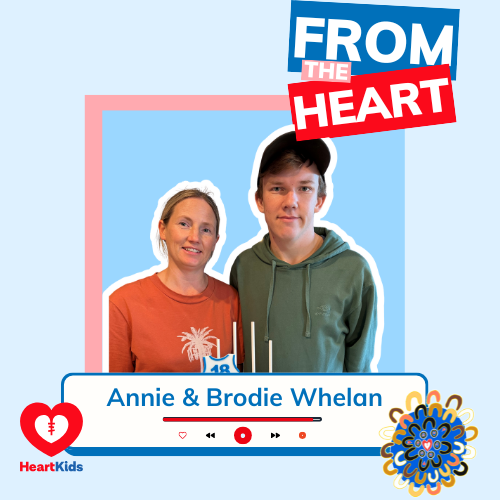
In this episode of the HeartKids Podcast, host Rachel Knowles speaks with 20-year-old Brodie and his mum, Annie, from Tasmania. Brodie has lived with childhood-onset heart disease and has undergone not one, but two heart transplants — the first during the height of COVID-19, and the second just last year.
Transcript
Rachel: Before we begin, we would like to acknowledge the traditional owners of the land of which we record. We pay our respects to elders past and present who are part of the world’s oldest continuing culture, and the first storytellers. We acknowledge the importance of supporting health for all peoples now and in the future.
Aboriginal and Torres Strait Islander people are warned. This podcast may maintain the voices and names of people who’ve passed.
Welcome to the HeartKids Podcast. Join us to hear stories of Australians affected by childhood heart conditions. On this podcast, you’ll hear from heart kids, and teens, heart adults, parents, carers and family members, cardiologists, and other health professionals. My name is Rachel Knowles, and I’m one of your hosts.
I’m a journalist and I live with a congenital heart condition. I was born with tricuspid atresia and had Fontan surgery at the age of two. I’m passionate about people and their stories, and I’m excited to walk with you on this journey as we share experiences and learn more about those of us living with childhood heart conditions.
Today I’m joined by Brodie and his mum, Annie from Tasmania. Brodie, who is now 20, has lived with childhood-onset heart disease and has undergone not one, but two heart transplants since Brodie first became unwell.
Life has changed in a lot of ways from traveling frequently to Melbourne for treatment, to managing his health and medications day to day. We’ll be talking about Brodie’s transplant journey, understanding what it’s looked like for both Brodie and his family. Welcome to the podcast.
Rachel: My first question is always, where are you dialling in from?
Brodie Tassie.
Annie: Tasmania. Devonport Tasmania to be exact.
Rachel: Beautiful. How’s the weather? How’s the weather?
Annie: Uh, next question. No, it’s not good. It hasn’t been good for the last months, has it? We’ve sort of skipped a season. We’re meant to be heading into, well, end of spring, but it’s like we’ve gone back to winter.
Rachel: Oh, that’s rough. I’m hoping that you get like a, like a quick pass to summer then. Like surely you deserve it. Beautiful. Well, we will jump right in. So, Brodie, you are our heart kid today. Annie, you are our heart parent. I guess, um, I might start with, with Annie. Can you take us back to the time when, and Brodie first became unwell and, and what his diagnosis was and what early days were like.
Annie: Um, well, Brodie, he was 14. He became unwell. Probably it took a good couple of months, didn’t it? To diagnose what was going on. Um, he was unwell all the time. Vomiting, lost a lot of weight. Um, several trips to the doctor. Had a high heart rate, high blood pressure, like there was lots of signs there, but you know, the first time they thought it was like a viral infection, which, you know, can cause all these sort of symptoms. And he just progressively just got sicker and sicker and we were like, what’s going on?
Rachel: That would’ve been really scary as a 14-year-old. Brodie, do you remember, feeling sick and that period of time?
Brodie: Just, yeah, feeling sick and don’t know why.
Rachel: Yeah. That’s super stressful.
Annie/: Just like not being able to do what you normally would do. Like everything sort of stopped, wasn’t it? Like, you know, just had no energy.
Rachel: When did you get the news that a heart transplant was something that, that had to be considered and potentially had to happen?
Annie: When we went to the GP, they thought it was appendicitis. They sent us, to the Burnie Hospital, and then we spent the day there. They were even going to send him home. The tests sort of showed that was inconclusive as well.
Lucky for us, there was a doctor on, there was two doctors actually, that picked up on the x-ray, just, I suppose, a fresh set of eyes. And this doctor, came in with the heart ultrasound machine, echo, he sort of knew what he was looking for, so. Yeah, he contacted by, a telephone call to the Royal Children’s and then it become quite serious, and we knew that he was gonna get flown straight to the ICU in Melbourne.
The thing is Brodie had his heart transplant through COVID. So the, it was a Saturday from when they flew him over. He got his heart. You had it what, 12 days later? Yeah, so I went, because it was only me and my husband that went to the hospital with him. We drove him down there. Because obviously we thought we were going down for appendicitis.
We suspected appendicitis. So we were like, right, we’re gonna go, you know, they thought they might’ve been, you know, we were like thinking in our heads, oh yeah. You know, if it is that he might have his appendix out. So, and we did. We spent all day and then when the doctors come in, that was about seven o’clock that night and, you know, just pretty much turned our world upside down and, you know, only one of us could go to Melbourne on the little plane, which was dad.
He went off, you know, we were still in the dark. We knew, you know, knew nothing really at that stage. We just knew that he was going to Melbourne and something, was wrong with your heart. It wasn’t functioning, you know how it should be. And it was enlarged and yeah, so I come home obviously to the other children, which we’d just left.
You know, and my head was just, I couldn’t even comprehend, what’s going on here. I wanted to get to Melbourne, you know, as quick as I could. But then it’s like, you know, and at that time the kids were wondering, but we didn’t know ourselves.
Rachel: Yeah, you can’t, yeah. Can’t explain it.
Annie: You’re like, we don’t even know, like, what’s happening, what’s going on, you know, from having a fit, healthy child who’s never had any sickness, never, you know, had anything go wrong, hardly any colds, flus throughout the 14 years. That was, yeah, very challenging.
Rachel: Yeah. And to be told that it might be viral to then all of a sudden being put on a plane is …
Annie/Brodie: Yeah.
Rachel: It’s a really distressing process.
Annie/Brodie: Yeah. So, no. Um, and my youngest, how old was Ella? She was four. I think was she four? 2020? She was three. Sorry. So you know what 3-year-olds are like.
Rachel: Oh my goodness. And that’s, yeah. Yeah. They pick up on things they don’t know, but they, they know what’s happening.
Um, I was born in a rural hospital and my mum has a very similar story of there was nobody there knew what was going on. They all thought it was, they were like, oh, I don’t know. There was one nurse who had done, uh, prac with congenital heart defects and was able to figure out what it was. And it, it’s kind of crazy that a lot of these stories come down to one person in the room being able to figure out what it is, isn’t it?
Annie: It is. Yeah. We’re very, very lucky, I think, that he was, you know, that somebody there picked up on it. They knew what they were looking for because it could have been a completely different outcome.
Rachel: Yeah, that’s the thing, isn’t it? Like I’m, sometimes the rooms are crowded, but I’m glad every single person is in there.
Yeah. So, you mentioned, so it happened during COVID. I’m really interested, I suppose, you know, living in Tassie and having to go to Melbourne. What was that process like in COVID?
How did your family cope with, with moving and whether you were allowed in the hospital or weren’t allowed in the hospital?
Annie: It was challenging. It’s probably one of the most, other than Brodie’s, you know, heart transplants and everything that comes along with it, but throughout the COVID period, it was so hard. Like we, I got, I shouldn’t say stuck, but when they started closing borders and shutting things down.
We were there and we, we were there for months on end. You know, I couldn’t get home. We couldn’t have any other family members come over. We were too scared to go out. We were in like a HeartKids apartment and you were too scared to even leave. Not that you were allowed to leave much except for medical appointments and stuff.
So it, it was tough. Very, very tough.
Rachel: Going through the, yeah, the medical process at the same time and being locked in a room is so heavy. Brodie, do you remember much of that time or is it something that you like, don’t like to remember?
Brodie: Uh, I can’t remember much when I was in hospital and then after, since after the transplant, you have to wear all the mask and apron and stuff. You had to, all the doctors and they had to wear. So it was fine. Like I, and then, um, yeah, and then when I got outta the hospital, I had to wear a mask and no one else did because that’s when COVID just started, so no one cared, so that was pretty embarrassing. I was wearing a mask. And, and then it happened and so I blended in.
Rachel: That’s good though. That’s good public health. We’re ahead of the curve. Yeah.
Annie: Felt like the odd one out. Duck bill masks.
Rachel: Oh, you poor thing. And so that was, that was the first transplant. So you’ve had a second transplant. When did that happen? What kind of, how, how did that occur? What was the process up to that one?
Brodie: Uh, that was July. June last year. June.
Rachel: So pretty fresh.
Brodie: June, yeah. Yeah. So, um. Sort of like in a way, like the first one, same type of things. Just like when it first happened, I was at work one day and I just all of a sudden had no energy, like I was getting outta breath. And then, yeah, it’s pretty much all I had really, and then I was, kept on getting worse and worse.
I was back and forth to doctors and they, they weren’t saying much. And then, yeah, it was pretty much just, um, then later on down track had gotten worse, like more.
Walk from like the lounge room to the toilet. I got, got really bad, shortness of breath, um, systemic pains, and sleep, like tired 24 7.
Rachel: Yeah.
Annie: And that sort of, obviously he was at the Children’s and he turned 18 and then went over to the Alfred, when you become an adult.
So that’s all, you know, everything over at the Alfred’s different to the Children’s. Yeah. So that’s, that was, a whole new set of challenges for us, and for Brodie.
Rachel: Yeah. How was it? I suppose, the transition process is, is really difficult to move between hospitals in one instance, but, to have, yeah, to have your procedure in a place that you hadn’t been before, you didn’t know many people, and trying to explain your medical history as well, I imagine would’ve been hard to advocate for yourself.
How did you find dropping into the adult system?
Brodie: Um. Yeah, it just sucked. Pretty much all I can say. Really. It wasn’t – just, at the Children’s they had free tv –
Rachel: Yeah.
Annie: Well, you were lucky though, because obviously the cardiologists work, you know, some of them work across, we found, like some of them were at the Alfred that were at the Children’s. And you know, the communication between the both, you know, is really very lucky that.
Rachel: Yeah. Yeah. It’s a good network in Melbourne.
Annie/Brodie: Isn’t it?
Rachel: Um, Brodie, what was it like, when you found out that you had to get a second transplant, how did you feel? Did you feel like nervous? Did you feel like upset that you had to go through it again? What were you feeling?
Brodie: Yeah, that’s like, it’s just like the same as the first one. So yeah, I was getting sick and I was getting worse and worse, and it always came across, I had to have another one. I was going back and forth to Melbourne and all that. And then, uh, last time I, before I had it –
Annie: You spent Easter in the Children’s, didn’t you? All over Easter. Like it was sort of a lot of hospital admissions and different treatment and trialling different things and nothing would work.
Brodie: And then with the second one, I had to, um, sort of got really sick again. Yeah. Didn’t, I was having the second one, I just got flown over there because I thought I was getting more treatment.
And then I was in ED down there for a couple days and then the doctor said, oh, as you probably know, you’re have on the list for another one. So that’s when I found out after spending a few days in ED .
Rachel: And then all of a sudden. How did, yeah, Annie, how did you feel like that would’ve been a bit of a shock.
Annie: Um, well look, I always, because obviously a lot of the times, well, most of the times with Brodie’s appointments, every time he’d come to the Alfred, the clinics and even the Children’s, I’d go with Brodie. So, you know, most of the time it’d be me that would go to Melbourne and, you know, we would, we would stay there for extended stays and you know, like, and then I suppose in April, with Easter.
It was Easter, wasn’t it, before you had it in, because you were in the Children’s for a good couple of weeks over Easter before you had the other one. And then you come home and you weren’t home for very long –
Brodie: It was like two, three days I think.
Annie: Yeah, two or three days. And then he was back and then it was like –
Brodie: Yeah, it’s pretty much just back and forth.
Annie: And we’d had, you know, that many appointments with the cardiologist and they’d done tests and everything was leading. Look, I think Brodie hides his symptoms really well. When he does get very sick, like I think he, he presented well, like he did last time, but was, you know, very, very unwell.
Rachel: I think that’s a really, um, it’s a really common thing that you can present – because it’s not like, you know, you’re not coming into the ER with like your arm hanging off. Like you do the bloods and then you do this and you, and even if you say, I’ve got heart problems, I’ve got chest pain. Like, you’re maybe up a little bit on the triage, but you’re not too far.
So what you guys are telling me is that if I need any Melbourne recommendations to hit you up, any cafes, any restaurants, um, which cafeteria in the hospital should I go to? Um, I, I’m interested though, because I feel like that kind of movement is like a lot of people experience that we don’t often talk about, that kind of travel and the weight of that and the financial burden of that and um, just how much that takes from you.
I know that like spending a lot of time in the hospital, like you do interact with a lot of people and I recognise though that some of that time has been during COVID, so that might not have been something that you’ve gotten to do, but have you made friendships or have you made connections with people in the hospital? What have your connections kind of been like or your support system been like?
Brodie: Yeah, I’ve met some few people. It’s good.
Rachel: Yeah.
Annie: I think the difference from the first transplant to when throughout the COVID and then when Brodie got sick, the second sort of time round when he was still in the Children’s, um, that was post COVID. Like, I think that’s when we met a lot more people and families because you could go and interact and you know, on the ward you could go and visit each other and you know, like that support and the people that we’ve met is amazing.
Um, you know, isn’t it? Like, and Brodie, when I couldn’t be in Melbourne and he was there, you know, for weeks on end, I knew that he was going to be okay because we’d met these other people who are on the ward and, you know their children were either waiting for transplants or that had transplants or that, you know, had cardiac, they were there for different sorts of reasons.
That was really, really nice because I felt like previously you were isolated and you didn’t really realize how isolated you were until, you know.
Rachel: Yeah, I think that’s, I was gonna ask you, Annie, like I think, um, these experiences are really isolated. And I think because you’re, you are rushing through the whole process and there’s not kind of a moment to slow down. You don’t get to sit. And even, when you are in extended periods of time, your time is filled up with doctor’s appointments and figuring things out.
And what’s been the value for you of, um, finding connection with people and having a bit of a community through those periods?
Annie: Oh look, I think it’s great. Like we still communicate with people. Their children have had, Brodie’s, um, made a really good friendship with another boy his age, Angus and Jen. You know, like when we were there, we’d go and have dinner, we’d order Uber Eats and we’d go and have dinner and, you know, take, get out of the room and you know, all meet up, get all the other mums and all the other kids, and, you know, like just to feel a bit normal because when you are confined to a hospital in four walls, a lot of the time you are just sitting there and you know, it’s all, you know, all the medical stuff that comes along with it, you know, you just need to take a breather away from it, I feel.
Rachel: Yeah.
Annie: It’s good. It’s comforting, you know.
Rachel: Yeah, I think it comes with a lot of head noise and a lot of nervousness. So being able to, you can talk to people about it or you can choose not to talk to people about it and just put it, put it, yeah.
And it’s just nice to know that other people are, are there.
In terms of, I suppose now, what do Brodie, what does your health kind of look like day to day? What does an average day look like for you?
Brodie: Mm. Normal. Except for taking medication.
Rachel: Yeah, that’s good. That’s fantastic.
Brodie: Yeah, pretty much just the same, I guess.
Rachel: Do you still have to travel much to Melbourne for care?
Brodie: I did for like, the past year and um, was always like once a month, twice a month, and then, yeah, and then went out to once every three months. I think now it’s just, I don’t go there anymore. Which is good.
Rachel: That’s a pretty quick turnaround for a year later. Like that’s impressive. Really good recovery. I think, uh, you know. In terms of the day to day though, what does the future kind of look like?
Brodie: Um, I don’t know.
Rachel: Yeah.
Brodie: Yeah, try and get forever out of it.
Rachel: What about you Annie? How are you feeling a year on?
Annie: Um, look, I, I feel very, um, grateful and thankful that, you know, Brodie’s been given another chance because, we know people that are still waiting. You know, we know the whole process and yeah, I just hope Brodie, looks after himself, all the things that you’ve gotta do to, you know, look after yourself as best as you can, and make the right choices.
And, you know, as a mum you just worry, don’t you?
Rachel: No, I think that’s the, that’s the curse though, isn’t it? My mum will always worry no matter how adult and independent I’ve become, she always will wanna be at my appointments. She’ll always want to know.
Annie: And that’s another part, like another thing, isn’t it? Like now you’ve gone to the Alfred, like the communication and everything used to come through me, but now they class Brodie as an adult, so …
Rachel: How are you feeling with the responsibility? Are you feeling all right, Brodie? Like, how’s it, how’s it feeling?
Brodie: It’s pretty easy. Just a lot text messages.
Rachel: That’s it. Just gotta get your referral and you gotta show up. That’s it, Annie, you’re doing better than than my mum. Sometimes she needs me to voice record the whole appointment so she can listen in still. So you’re doing much better. Doing much better. I know you mentioned earlier Annie, um, just quickly in a reference, about HeartKids and the apartment that –
Annie: Yes, that.
Rachel: Tell me a little bit about how HeartKids has kind of been along the journey.
Annie: Oh, they’ve been amazing, haven’t they? Like, you know, we were on that plane in Melbourne and we were sort. We were like, oh my gosh, our whole world has been turned upside down. And at that point in time we didn’t know, like there was talk of being in Melbourne, you know, having to relocate everything, which a lot of families do.
And that’s just their journey and what they have to go through. And they will be in Melbourne in the, for years before, you know, and that’s the thing, like we were like, what? What do we do? Like we’re so far from home and the apartment that HeartKids gave us was amazing. And you know, without that, I don’t know what we would’ve done.
We spent a couple of nights to start off with at the Ronald McDonald House, but they were all full. So, you know, we were like, okay, because there’s one right near the Children’s. But, so they were like, we could put you in one. I can’t remember where it was because it was dark when we went there and it was a huge building.
I was like it wasn’t near the children’s hospital. What was –
Brodie: Fitzroy? Fitzroy.
Rachel: Ah, yeah. Yeah. Okay.
Annie: Oh yeah.
Rachel: Bit of a distance.
Annie: We were there and then we were like, you know, because like obviously we know Melbourne now, but we were like, oh no.
And then, yep, so and then that didn’t last long. We just had to wait there for a couple of nights till the other one come up and then we were there for a while and then it was just good to get something more long term because obviously that’s what HeartKids do with their apartments. Max’s Place. I still look back at the photos.
It was cute. We spent a lot, obviously, because we were in there every day and you know.
Rachel: True. COVID isolation in there.
Annie/Brodie: The same TV shows. We knew what was on TV every day.
Rachel: You poor things. I, I’ve just, I’ve gotten so much out of this and I, we could ask you questions forever, uh, about your experiences and how you’re feeling, but I feel like I should probably wrap it up. I’ve taken a lot of your time.
You know, looking back on your experiences and where you are now and your health now, I think, would you say to other young people who might be getting a heart transplant, might have other heart conditions who finding it a little bit tough?
Brodie: I just, like, I guess it’s hard for people, but I just move on. Like, I just don’t think about it. And, uh, yeah, it’s pretty much it. Like it’s –
Rachel: Yeah. You just wanna live your life.
Annie: You just gotta think how lucky you are.
Brodie: Yeah, that’s, yeah, definitely.
Rachel: Yeah.
Annie: Some people unfortunately and sadly don’t get that choice, do they?
Rachel: Yeah, yeah. And Annie, for yourself, I guess like for any parents who are looking down the barrel of a similar experience, like what would you, what advice would you give them?
Annie/Brodie: Um, look at the start, it’s, it can be very tough. I sort of was in denial to start off with like, you know, this is not my life. This is, you know, I don’t want this. Do you know what I mean? Like, you just think, why me? You go through all the motions and, then I think you’ve really gotta flip it on its head.
And then you just, you grasp it, you deal with it and you think, this is my life. And you’ve sort of gotta look at the positives and you know, there’s always someone worse off out there. There’s always somebody that’s, you know, I think we’re quite lucky and I mean, we haven’t, obviously Brodie hasn’t chosen this and, and then I look at him and I look at the strength and the courage and everything he’s gone through.
You know, like there’s been many times where you’ve been in hospital and you think, oh my gosh, you know, these poor children. I don’t know. You just gotta draw on, draw on your strengths and you will find them.
Rachel: In those moments.
Annie/Brodie: yeah, you do. They’re there. You just, it might take a while to, you know.
Rachel: Yeah.
Annie: And I suppose having conversations with other people too, which has been, I think, through HeartKids and, you know, we know, you know, people that work for HeartKids and they’re, they’re based in Victoria.
You know, we still, had some really good friendships and support and met a lot of other people in the same position. But yeah, like I said, I just think. You just need to –
Rachel: Yeah, you gotta do the best with what you’ve got.
Annie: You do the best that you can with what you’ve got. Take each day as it comes and just, just the gift of life is the gift of giving, and you just have to think yourself that I’m still here and we are lucky, you know?
We’re very, very lucky.
Rachel: Yeah. I think that’s, you give it, you fight as hard as you can and feel good, you fought for what you have.
Annie: Yeah, that’s right. But yeah, be strong and lean on others if need be. And you know, don’t shy away from it. You know, like I did to start off with because yeah, you do. You know, your life can be turned upside down, but there’s always something worse off.
Rachel: I think one of, one of those things when everything kind of does get tips upside down, you just kind of lock into like, what do I need to do? How do I get this organised?
Annie: Yeah. Yeah.
Rachel: And you can, um, one of the other guests described it as a bit of a vortex. You kinda get sucked into this.
Annie: Yeah.
Rachel: You gotta remember to reach outside of it.
Annie: Yeah. It’s like you’re on a rollercoaster and you just gotta go along for the ride.
Rachel: That’s it. You can’t get off. Oh, well thank you so much for your time. Thank you for letting me poke you and prod you with all of my questions. I’m really grateful.
Annie: It’s okay. And yeah, I’d like to give a real, um, big shout out to HeartKids and everything that they do, and, you know.
Rachel: Oh, it was wonderful speaking to you both. Yeah, they do God’s work. Absolutely they do. Um, but no, I’m very, very glad to hear that, what I kept saying one year, but it’s almost 18 months later now. But congratulations and, um, really, it’s a beautiful, yeah, beautiful successful story.
Brodie: Yeah. Thank you.
Annie: No, thank you very much for, um, for speaking with us and we wish you all the best as well.
This podcast deals with some heavy things. If this brings up anything for you or somebody that you love, it’s important to reach out for help. The HeartKids Helpline provides support, advice, and guidance for people impacted by childhood heart disease. You can call the helpline on 1800 432 785.
To access more information about childhood heart disease, as well as support from HeartKids, visit the website, heartkids.org au.
The information on this podcast is not a substitute for medical advice from your doctor or healthcare team. Always talk to your doctor about matters that affect your health or your family’s health.