

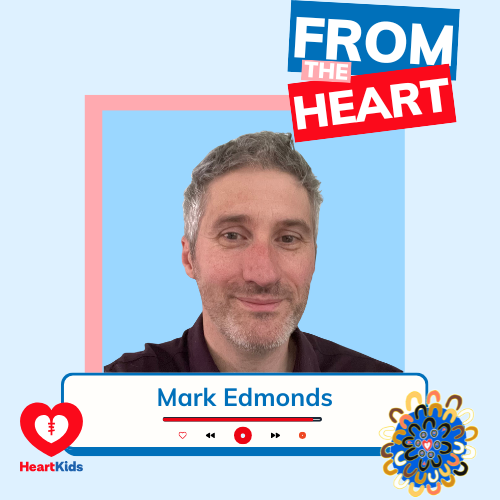
In this episode, host Sami Glastonbury speaks with Mark Edmonds, Education Project Coordinator at HeartKids, about the power of co-design and education in transforming care for people living with childhood-onset heart disease.
Mark shares how his background in neurophysiology and teaching has shaped his approach to developing national education modules for healthcare professionals, ensuring care is holistic, evidence-based, and grounded in lived experience.
Together, they explore how education is helping clinicians across Australia better understand the complexities of lifelong heart conditions, strengthen communication and mental health awareness, and ultimately improve outcomes for families.
Transcript
Before we begin, we’d like to acknowledge that we are recording on the traditional country of the Kaurna people of the Adelaide Plains. We pay respects to elders past, and present and we pass that respect to any Aboriginal or Torres Strait Islander listeners.
Hello, and welcome to From the Heart. I’m a Heart Parent, and your host Sami Glastonbury.
Sami: Today on From the Heart, I’m joined by Mark Edmonds, Education Project Coordinator at HeartKids. Mark has a long background in neurophysiology and now leads the development of education resources for healthcare professionals as a part of the National Strategic Action Plan for Childhood-onset Heart Disease.
His work focuses on co-designing materials with experts and families, ensuring the workforce is equipped to navigate the complex puzzle of conditions and care needs in CoHD.
Mark: What we’re trying to get the healthcare professionals to think about. That, holistic thinking around care is really important, but also making sure that, patients and families are essential to care as well and partnering with them as well. So that’s one of the things we’re hoping to really see a difference in.
Sami: So a very warm welcome to you, mark. Tell me where you joining us from today.
Mark: Hi Somi. I’m in Naarm on Bunurong Country, which is in, in Bayside, Melbourne. Beautiful place.
Sami: Lovely. I’m joining from Kaurna. So Mark, can you start by just telling us a bit about your role at HeartKids, because the intro’s quite, it’s quite complex. I’m sure there’s people listening saying neurophysiology education background. Now you’re co-designing for health, practitioners around Australia.
So tell us a bit about what brought you here, what brought you to HeartKids.
Mark: It’s a good question. So I sit in a part of HeartKids, which is called the Action Plan Team. And we’re responsible for implementing the National Action Plan for childhood-onset heart disease. And that’s got lots of moving parts.
One of the really important parts of that was the Standards of Care, which are up and running , but I sit there as the education project coordinator, and basically just design education materials and resources for our healthcare professionals to try and improve outcomes for the CoHD community effectively.
So neurophysiology is not really very well related to cardiology.
Sami: No. And that’s why I’m thinking how I, I need to understand this more.
Mark: There’s a lot of commonalities between the two. So neurology has a lot of chronic health conditions as well. It’s kind of a bit of a running joke, but we don’t fix very much in neurology at all.
We manage people, a lot of people with lifelong conditions. And a good example of that is something like epilepsy, again, something that can start in childhood and carry on for the rest of your life. So that kind of understanding of chronic healthcare is really important. Multidisciplinary care as well is a big part of that too, so overlapping with other, other health professionals to try and improve outcomes for patients as well.
And that’s a really core part of childhood-onset heart disease care as well. So that, that’s kind of the. But I’ve got, obviously got a fairly good understanding of how healthcare works, and most importantly, the relationships with patients and families as well.
And in more recent years, I had an academic teaching role within the University of Sydney teaching clinical neurphysiology as well. So becoming, getting a bit more into that kind of formal education space.
Sami: So it sounds like you love complexity. It sounds like even your background is quite complex, so I suppose that really feeds in to the complexity of childhood-onset heart disease. And as you’ve probably, you just kind of touched on, there’s so many multilink sort of conditions. So how do your modules help other healthcare professionals understand our space better?
Mark: So the Standards of Care have really given us this high level framework, to guide how we provide care in this space moving forward. And when you actually look through the Standards of Care, there’s not a great deal of focus on, on clinical expertise within surgery and things like that.
What you typically associate with cardiac care. Actually, when you look at it, it’s, it’s all the stuff that surrounds that really. It’s what we kind of call comorbidities which are basically non-cardiac conditions and also stuff like communication, mental health and all that kind of stuff, which a lot of healthcare professionals don’t do a great job. Where we think very much about our own areas and not the broader kind of picture that surrounds the patient.
Sami: So it almost sounds like we can sometimes be a bit myopic and what we’re trying to do is be more holistic.
Mark: Exactly. And that’s the real goal here, is to try and push things along into more holistic thinking and thinking outside of your area and where you can overlap and where you can, you know, intervene and escalate care when needed as well. And that, and that’s right across the board. It’s so incredibly complex because of not only the life journey of the patient. So as you know yourself, things can start in the prenatal period. So you can receive a diagnosis then, and it can go a 90% of our patients now fantastically survive into adult life as well Also, we’re moving beyond just managing the condition itself and looking at survival and really starting to think about this holistic care. And that’s what a lot of this work is really concentrating on and we’ll revisit clinical kind of expertise in other areas as well. But there’s a lot more kind of bigger picture comorbidity, you know, patient-centred care priorities in the education.
Sami: Mark, if I can just, if I can just hold you on that point too. Isn’t that just phenomenal in itself? You just threw out just a bit of a stat there. If you think about where we began, we began, you know, we were known as Blue Babies. We were blue babies and you know, and I’m sure there’s a lot of, um, records that probably don’t even exist about, they were actually cardiac babies that actually passed. And then you think about where we are now, like you just said, it’s that we’re in that space now and, and obviously we talk about it in HeartKids that we are there for life and, and it is, it’s that journey now. The journey, the, the path has, is extended. We’ve now got National Standards of Care, like you said, that high level framework. So there’s so much that has to go with that. Like you said, you don’t have these clinicians or we don’t just leave a practice and also to have this vast understanding what goes around a child with CHD. So can you talk us through some of those education pieces that, that you’ve developed or you’ve seen that there’s these massive gaps that we need to plug?
Mark: Yeah, look, the beauty with this is that there are lots and lots of people working in the field who’ve got amazing expertise in, in this really kind of specialized areas , so things like neurodevelopment, mental health, transition of care. I’m basically listing the modules I’ve done already. Genetics, all these really, very complex areas that the general healthcare community needs to have some oversight over and some education in, and know where they fit into that kind of process around the care in those areas and that’s, that’s the goal of a lot of this work.
Sami: I’m fascinated by even just the level in which you are having to think every day, and then you’re having to identify these areas.
Mark: And the beauty of this education as well is that it’s Australian specific context as well, so there’s lots of research out there that we can tap into, but a lot of that is kind of theoretical and some of it’s a bit more practical.
So things like consensus documents and, clinical practice guidelines are really helpful, but a lot of those aren’t Australian. So the Americans are very good at this, as an example. So things like the American Heart Association and the American Academy of Pediatrics produce these fantastic, you know, consensus documents and clinical practice guidelines to help guide American physicians to, you know, look after people with childhood-onset heart disease. We’re in the process of developing those at the moment, and that’s part of the Action Plan as well. So, clinical practice guidelines are being developed in this country as well.
But one of the real challenges of the work that I’m doing is taking what we’ve currently got, making that relevant to an Australian audience so that they can help patients now while we’re developing the clinical practice guidelines. So what’s out there and how does that sit in our context? And that’s where the healthcare professionals and the people who have lived experience are so good because they give me the realities.
We have the Standards of Care, which you’ve got these, kind of high level frameworks to guide. But lived reality for a lot of Australians doesn’t at the moment fit within in that framework. So it’s how does this apply and what do we need to develop with the education? So one of the major goals is to develop some pragmatic resources that can help healthcare professionals now to deliver services better, and understand how to deliver care.
And that’s where the lived experience is so crucial because the people on the ground who are performing this will say, ah, that’s not gonna work Mark, because this is the reality of the situation. The patients who form part of the working groups as well, and the families who form part of the working groups will also say where we don’t have a, the healthcare professionals aren’t providing us with X resource. Can you develop that resource so that that can be shared around the country?
Sami: Lovely. So you’ve got that really, really informed approach. Yeah.
Mark: So it’s, but it, it’s so complex and we have other things to help us as well. So at the start of this project as well we looked at some priority areas for education as well.
So we make sure with every single bit of education we develop that. We try and hit as many of those priority areas as well. Things like, care pathways or communication techniques. So there’s eight of them all together. So we try and take as many of those off as we can. And within the Standards of Care, even though we’re addressing, say, neurodevelopment, we may also cross over into mental health because they’re intrinsically linked. So we’re going back to prenatal times. We know that if mothers have, you know, mental health challenges in pregnancy that can impact the neurodevelopment of their child.
Sami: Really? Do we know that?
Mark: We know that.
Sami: So I didn’t know that, and I’m sure lots of people listening didn’t know that.
Mark: Yeah. So, and a lot of healthcare professionals don’t know this as well. So yeah, getting people aware of that, those kind of things means that we can get early intervention in place. And refer on to people who can help that mum who’s struggling to make sure that her unborn child has a better outcome.
So we have to think about all of these, you know, kind of complimentary areas as we’re developing the education and make sure we’re ticking as many of the, the boxes off as we can.
Sami: So Mark, I’m gonna break it down really quickly for everyone listening. Where on earth do you start?
Mark: Right.
Sami: Yeah, where do you start? Please share.
Mark: I have a process. So, it usually starts with the Standards of Care so that they provide, you know, some guidance. So if, say for instance, I’m gonna develop some modules for neurodevelopment, I’ll start there and go, well what, what does the Standards of Care want us to achieve as part of the implementation and how can we support that with the education?
Sami: Okay.
Mark: So that’s kind of my starting point usually. What we’ve also done is we did some gaps analysis back at the start of this project as well to look at where resources are at currently. Now that gaps analysis is pretty redundant now because things move so rapidly in science.
Sami: I was about to say, obviously coming from a different lens, I’m thinking about a SWOT analysis. I’m thinking that that that gap or that SWOT analysis is a moving target. I’m thinking you almost need to look at it, you know every couple of months, but realistically, probably weeks sometimes.
Mark: So within, before I start any new topic, I look where all those things intersect. I look at the evidence myself, generate some key topics, and then I get a working group together. So that’s formulated with healthcare professionals are relevant to that topic. And that’s, as we know, it’s usually multidisciplinary.
It’s not just cardiologist, it’s, you know. Neonatologists, physiotherapists, speech therapists, all sorts of wonderful people that you might not be aware of. And I have to do a lot of work to try and work out who I need in that group. And then within those professions, you need to find people who’ve got subject matter expertise in that area as well, or at least in, at least a strong interest in that area.
Then most importantly, we want people with lived experience as well. So we wanna get patients and families who are affected by that particular kind of domain or, or subject that we’re gonna tackle.
Sami: I love that. I love that you’ve brought in that lived experience piece because that’s the part that I think we’re really adopting quite rapidly in loads of these spaces.
Now is the lived experience and how that informs and shapes pathways moving forward. So how do you think that’s informing you know, your education work?
Mark: It’s really crucial and I mean, we need to really need to remember the Standards of Care as well.
We’re based on this too, so we got lots and lots of healthcare professionals together, but we also got lots of people from lived experience to help us co-design those resources. And we’ve carried that through to this project as well and what they bring is the lived reality of care in Australia and Australia’s such a, it’s such a complex area. Like CoHD is such a complex area, but it’s made even more complex by the geography of Australia as well. So the fact that 70% of us live in in cities and 30% of us don’t, really changes how care is delivered for that 30% of people who live in regional and rural Australia as well.
So getting that experience of, that broad experience of people around the country really frames where we’re feeling and what we need to do better and what resources they need to help them do that.
Sami: Yeah. So it sounds that that co-design piece is crucial for the outcomes. Because as you said, the whole 70-30 and that continuum of care looks vastly different for that 30% who are in regional or remote.
And on the podcast we talk a lot about what that journey looks like, even in the role that I play. In that conversation piece is different to when you can just know that you can call an ambulance and you can get to a hospital or you can drive there yourself, is vastly different to someone who says, well, actually no. For me that means calling, you know, outreach and then waiting for a medevac or whatever it is to get to a place of care. So that’s wonderful to understand and for our listeners to understand that a lot of the work we do is purposeful because it is co-designed.
This is not something that, like you just said, even just the Standards of Care. We had those working groups that informed so it’s not just the Standards of Care that are coming through the lens of a clinician, it’s coming through the people that actually have experienced that care.
Mark: Absolutely. And it, and they play such an important role in this education, in really highlighting where there’s resource deficits effectively.
So I would, you know, well, I’ll give you some examples. As part of the exercise modules, where we very first started. And we had some, some brilliant lived experience people in there who really changed the education to be quite frank. One of the things that one of the mums said was that, her son really loves to take part in community sport, but the people that support that at the community level were always nervous about how much they could do and how far he could kind of push himself and just some simple guidance for community sport and or schools or whoever needs it so that he can take part in that would be life changing. Now, that’s something that should happen to a degree anyway, but a lot of the cardiologists aren’t experts in exercise and they’re themselves frightened about.
This is across the literature as well. They feel uncomfortable, you know, in that area. Making recommendations. So providing a tool so they can kind of get across the kind of sports they can do and how much exertion they can withstand.
Yeah, those kind of things were really important. So we designed an exercise prescription and some tools to help ’em get there. Rachel Cordina, who’s, Professor Rachel Cordina, is an expert in exercise stuff, guided a lot of this work as well. So we’ve got some nice kind of simple tools for the non-expert cardiologist to get across that and feel a bit more comfortable and more importantly, give the patients and families a, a prescription that they can take away and with some clear kind of guidance onto how much they can exert themselves while they’re exercising, and those community organizations can feel a bit more comfortable with them participating. That’s some of it, it’s an amazing contribution from our patients and families. It’s, you know, it’s real life changing stuff.
Sami: Definitely Mark. And I think that the thing with that too is you almost think it’s a bit of a given. You almost think, don’t you like, oh, but you’re a cardiologist. Surely you should be able to recommend or say that I can do X, Y, Z or for how much time.
But like you said, it’s so complex and we really need that input across the board. So how, how important is it then, you’ve obviously touched on that lived experience in that and that other lens to, to inform. So you’ve looked at the complexity of what resources are out there. You’ve done the gaps analysis, you then get thrown a curve ball, you then bring in some other professionals.
How do you think this impacts the, the family Mark? So all this work and you finally then get it to a point where it’s a module or it’s a factsheet. How is it impacting the families? How do you, how do you see how that helps?
Mark: What we’re trying to get the healthcare professionals to think about, that holistic thinking around care is really important, but also making sure that, patients and families are essential to care as well and partnering with them as well. So that’s one of the things we’re hoping to really see a difference in, I think, and a lot of this is around communication as well, so kind of trauma informed and, and family centred care.
Uh, and that’s probably where the patients are gonna see it most. That empathetic voice. If we can build that and bring patients along on the journey and make them part of the solution to how care is delivered, it’s gonna be more effective. And that’s probably where patients and families are gonna see it.
Not in the kind of kind of clinical specialist kind of, applied kind of mechanistic care. It’s gonna be more in that touchy feely stuff and how that’s sold to them and how they’re involved in it. And there’s, I mean, there’s a bit of a cliched thinking in education. You know, people don’t remember what you say and, and they don’t necessarily remember what you do for them, but they remember how you make them feel, made them feel.
That really applies in healthcare as well. Uh, so if we can at least move our healthcare professionals to getting patients involved more in care, they’re gonna be, they’re gonna have better outcomes. They’re gonna stay in care. Which is really important because you’re gonna live a long time, hopefully, and, but we wanna retain you to care or even we don’t want you dropping out of care, particularly these crucial early students as well.
So those things are really important and that’s hopefully where patients and families are gonna see the difference.
Sami: I think that’s huge, Mark. It’s huge. And it’s just showing, again, like we touched on, we’ve come such a long way with medical intervention and it just makes sense that we sort of catch up with the EQ and the delivery. The delivery of that care. You know, we talk about it a lot about, you know, whether or not, um, you know, a clinician has bedside manner or I know as a heart mum myself, how the message was delivered. Um, and how then, too, how you receive it. Um, it’s a really important piece that, um, we have to be mindful of that.
The clinicians are humans too, and depending on the day that they’ve had or like you are, even just touching on the level of education in that particular space that they’ve received or have access to, can really have a really big impact on then receiving that care or being a part of that.
Um. I always refer to it, that village being referred, you know, in that village, and as I said, hearing and, and seeing. But I love how you just touched on that. Exactly that. We, you don’t, you don’t remember the exact words. And this is the thing that we even say to families is, you know, pack a notebook, have a pen, and, and if not, we’ll provide you one because you’re right, Mark, in those moments of overwhelm, devastating moments we are not hearing every little minor detail. Um, but we absolutely remember that feeling and we absolutely either have that connection with that particular clinician who’s sharing information with us. So it’s beautiful to know, and I think it’s really lovely for our community to hear the really important work you’re doing.
It’s more than just a piece of education, isn’t it?
Mark: Yeah, I think so. The other beautiful thing nowadays is in all of the research, in the literature is that patients and families want more information, but they want it when they need it, and they want it in a format that suits them as well.
That’s something we’re providing the healthcare professionals with as part of this education as well. So giving them easy resources that they can share. A lot of them produced by HeartKids, but outside resources as well, but all evidence-based resources as well, and in lots of different formats so people can learn about what they need to learn about.
These podcasts are fantastic now they’re, they’re fantastic. A lot of the stuff that we’ve got that are videos and fact sheets that we already have are amazing resources that people just don’t know about. So things like these podcasts are not only helpful for the patients, though I also share them with the healthcare professionals so they understand the lived experience as well.
In fact, you are, you are in one of the more recent ones on antenatal care. For patients talking about receiving that initial diagnosis and how life changing that is. Those kind of, again, building this empathetic kind of data banking in the healthcare professionals so that they’re aware of how people are. Not just we need to fix this heart, but we need to fix the family. We need to, you know, we need to help them on their journey. So if we can, if we can weave that through all of the education, we’ll have better outcomes for families. And that’s really a, a driving goal of what we’re doing and with the education and the Standards of Care.
Sami: And I think it sounds like it’s driving you too, Mark. It’s lovely. It’s lovely to hear you talk so … Uh, I don’t wanna use the word passion because it’s so overused, but I can literally see that burning is inside you and the hunger to constantly improve. So what are your hopes, what are your hopes for CoHD and that education and that workforce development?
Um, yeah. What are your hopes for the future? How we can further develop this?
Mark: Well, I hope we can keep going. I mean, one of the problems we’re running into at the moment is with the funding may stop from the government, but I’m hoping we can continue the work, but as I develop the curriculum, so curriculum is basically a collection of educational works together.
As we develop that curriculum, it’s so abundantly clear that it all overlaps. The more we can develop, the better. So I just wanna continue the work and address all of the key stuff, and then we can revisit other areas that healthcare professionals want us to develop as well. But the other blessing and a curse, as we talked about right at the start, is that the evidence changes all the time.
So consequently, these will need updating as evidence changes. And the other amazing thing that’s happening, is that we’re gonna have clinical practice guidelines in Australia as well.
Sami: Wow.
Mark: Specific to our services , that’s gonna take a while. But again, embedding that work into the education would be amazing.
But yeah, ultimately moving care onto, a more patient centred, strength based kind of care is really one of the major goals of this work. And real recognition of the impacts of mental health within care, neurodevelopment, our priority populations as well. The fact that, you know, we’re a diverse bunch in Australia we are living with disadvantage as well, particularly our First Nations people and people in regional and rural Australia as well.
If the education can help even the playing field a little bit, that would be good. And that’s a crazy high kind of, uh, goal. I’m not really realistic, but –
Sami: No, I love it, Mark, because I think you can’t have so many passionate people like we do at HeartKids, and not strive, not keep striving and have those visions and those goals.
And you know, for families listening. The importance of this work, and I have to reflect when I heard, when we got our diagnosis, we were living in a regional town, we then had to drive, drive home. You know, it is not by means a long drive if you are in Sydney and Melbourne. This sounds like a normal commute, but we had to drive an hour and a half home to a country town, we were told not to Google. Don’t Google, don’t research anything because anything you’re gonna look at is going to be specific to, as you’ve just touched on, America, Europe, the, um, the statistics you’re gonna see aren’t gonna be relevant to Australia, but just sit tight and we’ll get back to you in a week.
That in itself was huge. I sit here now. So, so, so proud. It actually, as you can hear it, it, I’m so proud of the work that you, Jess and the team and everyone in the Action Plan, but all the people before us, that also too, that rallied, rallied government to get this funding so that we have these resources that are relevant, they’re relevant to our families, they’re relevant to our clinicians.
And like you said, it’s so complex. I, I’m constantly talking about CoHD. A lot of people, childhood-onset heart disease, they say, what is it? I say it’s an umbrella term because there’s so many paediatric and infant and childhood conditions and defects and diseases that fall under that. We can’t, we can’t leave people, you know, we’re on the bus now.
We can’t not let people get on the bus. We need people like you, Mark. We need to, like you said, keep continuing developing those resources, um, because as we know tomorrow, babies, eight babies are gonna be born today, another eight tomorrow. This is going to go on, as you said to start with, 90% of people are now living a full life.
Um. So what do you want with those families? I’ve just banged on because as you can hear, I’m so passionate about it. It wakes me up every day, it’s why I get out of bed every single day. What, what do you want families to take away from the, from the work that you’re doing?
Mark: Oh, well, the first thing to take away is our healthcare professionals in this country are amazing.
We have incredibly good care in this area as it is, but it can be better. But those healthcare professionals put in so much time and effort to move, move, move the dial in the right direction. I’ve been blown away by their commitment. They all give their time for free. I’ve had in my working group so far, I’ve had 65 people who’ve given their time for free for time.
Sami: and there’s so many people that wouldn’t know if we weren’t having this podcast now and talking about that, people wouldn’t realize, listen, listen to that. 65 clinicians who are already probably working 80 plus hour weeks giving up their time to improve our health outcomes.
Mark: Yeah. They’re just amazing people.
And the same for the families and patients that give their time as well. My mental health working group. It was a tough working group. You know, trauma is a real thing and it brings back a lot of those kind of, memories and, it was a tough as for a lot of people in that group and for the healthcare professionals as well.
You know we’re not made of stone and you know we deal with tragedy pretty, pretty frequently as well, so just putting yourself out there and being part of it is a big ask for a lot of people, not just from a time perspective, but from an emotional perspective as well. And we really salute all of the healthcare professionals and those people who lived experience that kind of give their time.
I try and minimize the time. I do virtually all of the work and we have a few meetups and they give me feedback on things. That’s how the process works. But you know, I couldn’t do without them and I’d be, be lost, lost at sea. It’s hard to hard to find your way forward with a lot of these projects because they’re so complex.
Uh, so yeah, big salute to them. And if there’s anybody out there who wants to get involved in future working groups as well as either a patient or a family person with a lived experience, we’d be very happy to have you on board. And hopefully this work will continue. But we’ll have to wait and see.
Sami: Yeah, absolutely Mark. And I think that’s a, it’s a beautiful thing to, as a, as a call to action is we’re saying absolutely, you’ve got a voice, you’ve got experience, please, you know, bring it all, bring it all into the melting pot, along with the clinicians and everything. And I think it also too, is a testament to the work that you do, that this is not just something taken lightly.
This is not just something that you just whip up. You don’t just whip off a document and, and hope for the best and go, this is my opinion or my view, or this is what a textbook says, or whatever else. I love the fact that it’s a real melting pot of so many different experiences that create these education modules and and fact sheets, which are all downloadable on the site or for clinicians.
It’s there for anyone and everyone, which I think in itself is, like you touched on, we’re very fortunate in this country. I think we’re very blessed, like you said, with the level of clinicians that we have. So, to wrap this all up, Mark, because this has been incredibly fascinating.
I’ve absolutely loved chatting with you. So you’ve had a long career. It’s fast, it’s complex. What keeps you motivated in this space?
Mark: Coffee, largely.
No, no. Oh, look, I’ve got a real curiosity for the science and, you know, moving things forward, but it’s, yeah. Look, what keeps me motivated, I think this has come across quite well, I hope is, is this community’s amazing and,
The experiences of Australians in this area really drive me to want to as do a good, a job as I can and move things forward. And it’s as simple as that really. How could you not be inspired by all the amazing people like HeartKids is such a collective of people coming together to, improve outcomes for CoHD around the country.
And it’s really inspiring and that’s at a healthcare professional level, it’s a staff level. Our amazing support workers, and this has been a real key, I must say this as well. One of the key themes of all this education is using peer support. It’s in all the research, all of our lived experience. People say what a difference it makes.
That needs to change and become more part of how healthcare professionals think and deliver their services, and getting organizations like HeartKids, some other organizations as well involved to support our patients. But yet, how could you not be inspired by, you know, the dedication of people in this area and, and how much people give just with fundraising or just helping out, helping, giving, giving the time. It’s amazing. It’s, yeah. It’s truly inspiring.
Sami: Well, thank you Mark. Thank you so much for sharing, and I hope that drive never switches off and I wish you many, many lattes, flat white, short blacks, however you take your coffee to keep you inspired.
Mark: Yeah. Double espresso. Double.
Sami: Sometimes this podcast talks about some heavy things. If this brings up anything for you or someone you love, it is important to reach out for support the HeartKids Helpline provides support and guidance for anyone impacted by CoHD. You can call the helpline on 1800 432 785. To access more information as well as support from HeartKids, visit the website at heartkids.org au.
The information on this podcast is not a substitute for medical advice from your doctor or healthcare team. Always talk to your doctor about matters that affect you or your family’s health.