

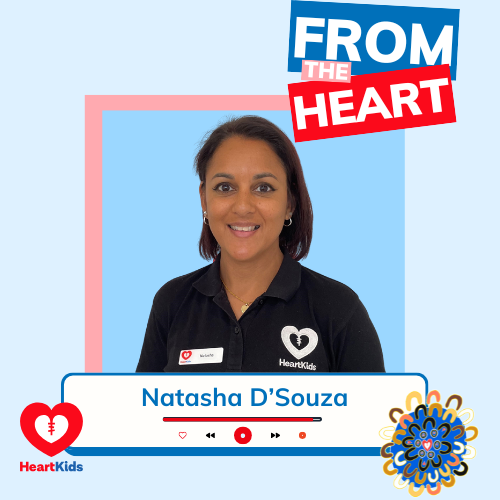
In this episode, host Sami is joined by Natasha D’Souza, one of our dedicated Family Support Coordinators in Western Australia.
Drawing on her own experience as a heart parent, Tash shares how she and the WA team walk alongside families through hospital stays, unexpected admissions, and the life-changing reality of having to travel interstate for cardiac care.
Transcript
Before we begin, we’d like to acknowledge that we are recording on the traditional country of the Kaurna people of the Adelaide Plains. We pay respects to elders past, and present. We pass that respect to any Aboriginal or Torres Strait Islander listeners.
Hello, and welcome to From the Heart. I’m a Heart Parent, and your host Sami Glastonbury.
Sami: Today we’re joined by Natasha D’Souza, one of our dedicated HeartKids support coordinators in Western Australia. Natasha brings both personal and professional insight with her experience as a heart parent shaping the incredible support she provides to families every single day. In this episode, Natasha will take us through how HeartKids helps families who need to travel interstate for cardiac care – a big step in many of our heart journeys, whether it’s for surgery, ongoing treatment, or a longer hospital stay.
Tash: For me, I feel honoured that I can be there for these families at their worst knowing that I had those same fears and worries when my son was having his surgery. I find strength in hearing their journeys and their stories and how much they celebrate those children. And yeah, just helps me be there for that next family that walks in that door
Sami: So a very warm welcome to you Tash. First of all, can you tell us where you’re joining from today?
Tash: Thanks, Sami. Thanks for having me along. Um, I’m coming to you today from WA, we’re in Perth, and sitting on Whadjuk Nyoongar country.
Sami: Beautiful. I’m coming to you from Kaurna. So Tash, you and I obviously both work in the organisation, so I hope you don’t mind. I’m just gonna refer to you as Tash ’cause it just seems quite funny to refer to you as Natasha. Tash, this is your second time on the podcast, so thank you for joining us again, and it’s great for listeners to hear more about.
Your personal story, but also too, um, so feel free to jump back. Anyone listening to one of our previous episodes which you can find on our website or we can go back through Spotify. But to start us off, could you share a little bit about your role at HeartKids, for those new listeners, but also too a bit about your own family journey, with childhood-onset heart disease?
Tash: So I am a Family Support Coordinator here in WA. This is my 10th year doing this job. It’s the job that I love with a passion that I’m able to, to give back to families and journey with them along their treatments, their hospital stays, many admissions, you know, worrying, extra diagnoses, things like that.
Just to have an additional support of someone who knows what it’s like, being there with my own son now, 13 years ago, um, was his last intervention and just feeding on that and knowing what it was that I needed in that space, helping them with what they need going forward with their children. So I became involved with HeartKids, like I said, about 13 years ago now.
When my son was diagnosed at the age of two years, he was undiagnosed until then. He was born early, post a miscarriage for me as well. So, they had extra scans.
Sami: Oh, so he’s a rainbow baby.
Tash: He’s my rainbow baby. But, yeah, totally missed at every given opportunity, and was diagnosed at the age of two following a chest infection with three defects on his heart, so a coarctation of the aorta, an ASD, which is minor, and a bicuspid aortic valve. So lots going on there. And he had surgery February 2013 to correct one of them, so they corrected the coarctation. And since then he’s 13 years post, he’s now 15 years old – literally last weekend he had a birthday – and, um, doing really well.
Stably. He’s taller than me.
Sami: Wonderful.
Tash: And just has an annual cardiac review now to watch that valve and the hole, and when the next stage of his journey comes along, we’ll address that and be a heart kid family again going through the system. But in the meantime, I get to support some amazing people out there with their journeys.
Sami: Yeah. That’s beautiful. Um, and it’s, it’s lovely. We’re so fortunate that a really big percentage of our team, have lived experience, and I think that’s really wonderful for people knowing that the support that we’re providing, we have that genuine understanding that when we look you in the eyes, we know exactly what you’re feeling.
Or should I say, we can very much relate because every journey is unique. So you’re based in Perth, so what does the role look like? Are you always based in the hospital or are you in other clinics or spaces?
Tash: So there’s a team of three of us here in WA. Marie and myself are located in at Perth Children’s Hospital and Ariana as well, but Ariana’s our regional coordinator.
So she will travel out to regional clinics with the cardiology team and visit families who get seen remotely in our WA locations. But on a day-to-day where all three normally rotate through the office at Perth Children’s Hospital, we’re very lucky to have space there. And we will be able to go up to the wards and to ICU to visit the families that are in for surgery or for just an admission for an illness which has brought them in.
Unfortunately, having a heart condition quite often compounds, what is regular for an everyday child can be a little bit different for a heart child. So. Um, yeah, just go in and just make sure the parents are supported. Especially if it’s been an unexpected admission. They sometimes don’t have the things they need or, you know, so we can try and help where we can, just even take them away from the bedside, have a cup of coffee with them to just take that stress load off them, and the hospital’s looking after their children so we try and go and just make sure that they’re okay. Because we’ve sat there with our children, so we know what it’s like. But yeah, mostly Monday to Friday we’re covered at Perth Children’s. And then Ariana travels as the cardiac clinic travels to the regions.
Sami: Yeah, so I suppose, with that, there’s no day that’s typical by the sounds of that.
It’s because we don’t know the admissions, we don’t know, like you said, you might start your day in ICU, you might be on the ward, you might start your day in the office. So it sounds really varied. And I really love how you’ve touched on that. A lot of people can sometimes be unaware and I think as a new mum too, the complexities that come with having a child with a heart condition in the respect that the common cold can pop us in hospital on oxygen.
And that sort of is a, it’s hard to sort of get your head around it first because you think, and I think because we have that diagnosis of the heart. You know, we do, and I don’t want to say the word panic, but we do, we do panic because we think, oh gosh, because we see that work rate of breathing and we get really worried and then we find out with a lovely swab that it’s the good old rhinovirus, the common cold.
And you think, gosh, most people would just be at home in bed and here we are in hospital. So, how many families do you think that you would support across, across the year? Because it sounds like all different types of admissions at different times and stages. If you had to put a bit of a ballpark on it, where do you think it would sit, Tash?
Tash: Our hospital list varies. Sometimes you’ll have as little as four or five a week total, up to it can be about, you know, 10 to 15.
So during the winter months, we definitely see an increase of just hospital admissions for those heart kids. But surgery stays pretty consistent through the year, so, oh, at a random guess, I mean, oh, maybe around 200, 300 families a year.
Sami: So as we’ve mentioned, varied day, varied complexities in with the different conditions being diagnosed, obviously surgeries. So tell me what you love about this work.
Tash: Oh, look, the thing that’s kept me here for this time is these beautiful families, um, knowing from experience, it’s something no family should ever have to experience is their child going through major open heart surgery.
Seeing them struggle in ICU and withdrawing from the drugs that comes with that major surgery you know, the complications and everything like that. But then seeing those children go home and, and live their lives as they would want to. But then there’s also the flip side. It’s, it’s a real emotional rollercoaster, but we support the families that don’t have the good stories as well.
The ones that have those complications that are just so severe, that takes the life of those children. But for me, I feel honoured that I can be there for these families at their worst knowing that I had those same fears and worries when my son was having his surgery. But I was lucky that I still have him that I can hold onto whereas some of these families obviously don’t. That might seem like something that would deter people from this role, but I find strength in hearing their journeys and their stories and how much they celebrate those children. And yeah, just helps me get through and be there for that next family that walks in that door and, and hope that they have a good outcome rather than a bad one.
You know, each story is so different and it’s the constant emotions, but I know what it’s like. Having had that rollercoaster, not the bad outcome. But yeah, just hope that I can impart some of that knowledge to more families there that should never have to experience this. So yeah, that’s what keeps me going.
Because I know so many organisations, so many other conditions I should say, don’t have the supports in place. Oh, I see it with our families who have children with other issues. You know, they come through heart surgery and they’re so well supported and the child comes back for a spinal and the surgery is so long and they get no information back, and they’re waiting for their child to come out, and they’re just that consistent worry.
So, as a HeartKids family, we will still support them through that surgery as well. But being there for that whole story of that child is, is what keeps me here. Knowing that I’ve made a difference in someone’s life to help them navigate what could be most difficult time.
Sami: Beautifully said.
So Tash, obviously we’ve talked about, your role, the role you play, the families that we see, coming through those doors of hospital with all different needs and different stays. But we need to talk about the families that need to travel, they need to travel interstate.
And I think it’s really good to sort of preference this part of the conversation that we’re going to have around the fact that there’s probably a bit of assumption out there that you’re in a capital city or there’s a regional, you know, you’ve got to travel from regional to a capital city. But I think there’d be that sort of misconception out there, people probably don’t understand that we sometimes have to travel from one capital city to another to get that extra specialised care.
So what are the ways in which HeartKids support those families that have to travel interstate? Can you give us a bit of an overview of what that situation might look like?
Tash: So we’ll quite often see the families here in WA before they go over and we will be with them most, more than likely when they get that news that they have to then travel. There are other families that we don’t get to meet, but we just get informed by the team who have let us know that a family has to move, relocate for surgery.
So we’ll try and reach out to them before they go. Obviously, it’s the most heightened time of stress and worry because one, my child has to have surgery. Two, I have to go over east to have it. And what do I do with my family? Who do I go with? Who gets to come along? How do I fund this? There’s so many things.
From the WA side of things, the government funds the travel for the child and accommodations for one parent. If anyone else is to go over, it’s funded by the family themselves. And then any siblings, et cetera, that’s also another thing on top of that. So HeartKids comes in, we all introduce ourselves.
We will also ask them if they’re happy for us to link them with supports in the other state. We have a very good relationship with Victoria and Queensland, which is where we send our families. And if they’re okay with that, we will make sure that the team in those states know that they’re coming, when they’re coming, and potentially what they’re going to have done when they go over.
And then we’ll try and set them up initially, thanks to Telethon, our funding here in WA we’re allowed to, we give them a voucher to set up themselves grocery-wise just to help with the costs getting down on the ground in the other state. And we’ll provide some ongoing support for them from this side.
But then just making sure, one, we touch base with them at regular intervals from a home state side, but the local team will take care of the day-to-day whilst they’re over there. And if any family is left behind, say the partner or the husband and the other children, we’ll make sure that they’re supported whilst they’re back home whilst the family’s away with the child who needs the treatment. So, it’s just making sure that they’re supported through something which is again, next level. One is your child having surgery, two, being away from home, having major surgery, or in the rare circumstances when they need a transplant.
The wait for that beautiful gift can take very, you know, it can be a month or two, it can take up to a couple of years. It sometimes, it just doesn’t happen. So, the families have to make that decision whether they relocate the entire family for that period of time. Because then even post-transplant, there’s, there’s follow ups.
There’s you know, regular, more regular appointments initially. Then they can move back home and have those follow up done at, at bigger intervals. So, yeah, trying to support them with all of that. And it’s just that touchpoint of someone who knows hospital stays and stuff like that. And the team in Melbourne and Queensland are very knowledgeable, very much on top of it.
They also have children with congenital issues, so they’re great teams to work with. And they know the ground around those hospitals like the back of their hands. So where to send people for help with accommodation and travelling around a different state to your home state. And like local things to do with your other siblings, you know, and just adjusting to have to live your life over there for a little while before you can come back home.
Sami: Yeah. Yeah. It’s, it’s a lot, isn’t it? It’s overwhelming and I really love the fact that you touched on that even if the family is displaced and we’ve got, say for instance the Victorian or the Queensland team looking after your WA team, the WA team are still wrapping their arms around the family that’s left behind.
And I think it’s a really important thing for us to really just focus on and let people know from our organisation perspective. For you and I Tash, that’s very normal, but I think that we need to probably, we need to amplify that that’s our real point of difference. It’s not just about providing that care in hospital, that care extends to the extended family and it extends to siblings, it extends then across states. And that’s the beauty of us being a national organisation and having those relationships and having, like you said, we’ve got our team on the ground. Like you said, they know it like the back of their hand, but they’re also coming from that lived experience.
So when you have to have that conversation with a family, like say for instance, tomorrow, Tash, touch wood, but let’s be realistic. It will happen that you get that call and it’s a family that you’ve got a relationship with, but you now know that they’re going to have to go interstate, for subsequent surgery and correction – where do you start the conversation? Where do you start it with them? Bcause there’s so much.
Tash: There is so much and, and I guess the first point is when? When are you leaving? Basically, how much can I offer you before you literally have to get on that plane and leave the state? So more often than not, once they’re told, they will get a date within a few days depending on the ICU if it’s needed at the other end or the availability of a bed at the other end.
For some that are emergent, they will have to transfer ICU to ICU and if that’s the case, they need to make sure there’s an ICU space available for them. The other ones, they need to go over and have surgery or wait for a transplant or be assessed for a transplant. So there’s, they just need a bed on the ward.
So depending on the urgency will depend on how quick their flight is arranged. And then again, letting them, you know, letting them know that we can link them in with the team. Once they arrive at the other end and just asking them how we can help them navigate the days or hours in what they need to get themselves and that child onto a plane.
If there’s anything we can do to assist, get stuff to them at the hospital, you know, help get family to bring things in that they need to then take with them. Because it’s quite, in most cases, it’s very unexpected and they’re just thrown a curve ball.
Sami: Yeah. And thanks for actually saying that because I was about to say, with your tenure experience, a decade on the job, in your experience, is it moment’s notice? Is it, you know, you, they’re in one morning and they’re gonna be on a plane that afternoon?
Tash: It can vary. Some of them need that emergent right, you need to go in now. They have to obviously, stabilize the child before they can transfer. So they’ll generally, the quickest I’ve seen a turnaround has probably been, you know, five to six hours for real emergent ones to, you know, 24 hours to a few days.
So it does really depend on the circumstances of the transfer, if it’s a known, you know, baby’s going to be born and it can’t be operated on here, sometimes they will transfer mum before she even gives birth, for those real complicated ones, so that the baby is born where they need the help the most.
So that’s just watching mum on a flight over, which is probably an easier job. But then there’s the ones that are born with the emergent needs and have to go over on a private jet. And that again, is another level of worry because if the jet needs the cardiac team, so the nurse, a cardiologist sometimes and the equipment, it sometimes doesn’t even fit mum in there. So mum has to travel alone on a flight at the same time and meet the child on the tarmac at the other side, which can be the worst trip of your life.
Sami: Huge. Absolutely huge. And like you touched on, you do what you do every day because you want to help someone else through this, but at the same time, you, wouldn’t wish it upon a soul.
The level of stress and overwhelm and anxiety and every other emotion we can layer in on it. And fear. Fear, sheer fear.
Tash: Am I gonna see my child at the end, you know, are they going to make that flight, for those really imagine ones. There are the ones who know that they have to go and in travel with mum or dad on the plane and are just there for when they need to have their surgery.
But there’s the whole gamut of different conditions and emergencies that do have to go.
Sami: Yeah, that’s, thanks for sharing, Tash, and thanks for giving us some insight. As I said, we talk to so many different people in this podcast and it’s always really good sometimes just to bring it back home for us.
Like, what is our BAU? what’s our business as usual? And I think sometimes people probably don’t understand that it’s not just about like, don’t get me wrong, the cups of tea on the ward I know are just as powerful and just as important. But then it’s that other piece where it’s that it’s almost crisis management, isn’t it?
That you’re helping a family navigate a crisis in their life, but ensuring that, they’re not doing it alone. We just don’t want them doing it alone. and I think both as heart parents, it strikes a chord, doesn’t it? We feel it on a whole body, cellular level.
So if we change it up a little here, Tash.
Tash: Yeah.
Sami: Let’s bring this now to a point where we can really help families listening to prepare. How do we prep for this journey? What are your sort of recommendations when it comes to professional and personal – what do we pack?
Tash: Yeah.
Sami: What are we packing Tash?
Tash: Oh, look, packing is probably the hardest things, but there’s, there’s a few little tips. Obviously you just don’t know how long you’re going to be over there for. Some children respond, well, textbook surgery, textbook recovery and you’re home again before you know it. Those that need to be there for longer, different story again. But initially we recommend taking your child’s favourite toy or something that brings them a little bit of comfort. They’re going to be in scenarios and areas that are so foreign to them and yourself. And just having that one thing that reminds them of home or few hundred things that reminds them of home, your whole suitcase full if needed.
But it helps them, you know helps settle them a little, I guess. I can never imagine what it would be like, but yeah, just something that reminds them of home. And for the parents. It can be long and, you know, daily they’re at the hospital with their little ones, so having something for you to do yourself as well.
You know, they might be asleep for some time in ICU recovering or, you know, so you know your laptop, and an iPad with the charging cables.
Sami: Excellent tip, excellent tip.
Tash: puzzles are good and colouring in like mandala colouring for adults just helps zone out and remove some of the stress, taking in some bit of mindfulness, you know because the constant worry by the bedside is not good for anybody. So have five minute colouring session. It can just help alleviate that stress for five minutes even, and it will be very restorative. Going for a walk. You know, most hospitals have a volunteer service that can assist with your child when you’re in hospital, so engaging in that, utilising that so that you don’t burn out.
Sami: That’s a great tip. I didn’t know that when I travelled, I didn’t know that there was that volunteer service so that I could actually just get out and get some fresh air. Yeah. Great, great tip.
Tash: It’s a volunteer that will sit with your child if they’re, even if they’re asleep.
And they’re trained by the hospital to, to do these things. So you can literally just go and grab a coffee, sniff in some fresh air. And, um, then come back a little bit more alive and willing to carry on with your day.
Sami: Yeah.
Tash: Even just a little bit. I remember my husband literally had to kick me out from ICU when my son was there. I was like, I’m not leaving him. And he’s like, no. Literally you are. You need to go. He’s like, even if you just go pick up Talia, my other girl, my daughter, and take her home, have a shower, you know, drop her at your mum’s and then come back.
It’s something, it’s time away from here. I will be with him a hundred percent of the time. You know? Um, but just as simple as doing something like that,
Sami: It’s almost like you’ve gotta be given a task because otherwise we wouldn’t do it, would we?
Tash: No. So yeah, that, that works. And having someone who you can trade out with, even if it’s the other, the team in Victoria or Queensland, you know, that can take you for that walk and, and just grab a coffee with them and then come back and, you know, just doing little things like that to help you manage.
Tash: But, um, yeah, I don’t know much else of what to pack except the little essentials.
Sami: Yeah. I think though you’ve touched on some nice things. I think also too, as parents and caregivers, we go into that mode of thinking about what our child needs, but sometimes we forget that we have needs too, and we can’t keep giving.
And I like even just, like you’ve just said, like even colouring in or Sudoku or something that in that moment that you can just reach into your bag and grab, and in saying that, I think you’ll probably find all of us, in HeartKids have probably got a little stash in all the hospitals.
So if you’re a parent listening and you’re thinking, oh gosh, I wish I did that, or I’ll remember that. And if you don’t in the moment, don’t worry. I’m pretty certain we’ve got your back.
And so, we touched on it a bit earlier, Tash, around the support for the siblings or the family left behind. Do you have any, do you have any thoughts or sort of wisdom to share there?
Tash: It’s always hard. You never want to split your family in a situation like this. But for some it’s necessary financially or you know, kids are in school or they’re in a vital year of school and it’s the younger sibling that needs the heart treatment, so it becomes necessary to leave people behind. So making sure that you know that here, that they’re okay and they’ve got everything that they need to get through as well.
So touching base with the parent that’s left behind, or, you know, and just seeing if there’s anything, or any way we can assist them as well. Just making sure they’re covered so that they don’t feel like they’ve just been left here whilst the other child’s also, you know, their needs are being addressed obviously, and more urgent, but the sibling here is not forgotten.
Sami: That’s right. They have just as many needs. And I reflect upon my own personal journey we had, no family in the state. So we left our two girls behind with 10 families. I remember I was very fortunate. I had 48 hours before we had to fly. So in that time could write a roster, send off multiple text messages and, and create a bit of a roster of who was picking. I had one in childcare, one in kindy, when Frank was born, but I reflect upon it now, Tash and I actually don’t know how, how, how we did it. And I just remember. You, you, you think, how can your heart break twice? And it, it did. It was breaking while I was there, but I was also somehow semi relieved that my son was getting the intervention he needed. But then my heart was breaking that I wasn’t with my girls, but then at the same time, I knew they were safe and being cared for. So it’s such a journey, but that’s beautiful to know that no matter where you are in Australia, we’ve got that team to, like you said, if you’ve got a team traveling from WA to Vic or Queensland and you are there on the ground to support that.
And I hope that that brings, you know, some peace of mind. To those families, but also to the people listening to, really understand that we really do cover this very large nation of ours. So Tash, if we can think back upon your own journey and the families that you’ve supported, what’s something that you’d say to a parent currently preparing to travel interstate for their child’s care? Like if there was just something that you’ve picked up along the way from other people’s feedback in your own personal feelings as a heart mum, what would you share?
Tash: Oh, look. Don’t downplay it. Trying to be, have a brave face above it all is crazy. Live in that moment. And it can be very overwhelming having that surgery in your own state. But having to travel is next level. So don’t dumb it down, and accept every piece of help that is thrown your way. Whether it’s to help with the family staying behind or to get you guys over there.
You know, you can only be as helpful yourself to your child if you are functioning and if you’ve burnt out because you’ve tried to do everything single thing yourself, including looking after any family left behind, you’re not going to be functional for the child that you’ve got to have this emergency care for.
So making sure you take time for yourself so that you can be there for them when they most need you. You’ll find a strength that you never knew you even had. And with the support of HeartKids along the way, it’s a journey that’s a hard one, but it’s something that you will feel not alone on.
And hopefully we can help get you through and back home before you know it.
Sami: That’s beautiful, Tash. I love it. Beautiful words of advice. you don’t have to have a brave face. You don’t have to take it all on. Even though we do talk about our courageous heart kids and how, you know, the challenges they face and how brave they are with their little hearts, but a great reminder that as parents, we can’t possibly do it all. And to accept those, times of help or the cups of tea. If you have HeartKids come around on the ward and even if you probably don’t even need it, just say yes. Just say yes, and just feel that warmth in your hand and that warmth in your heart that’s coming from one of our support coordinators that understand the journey.
Tash: Make, make use of that village. That village that will keep you going.
Sami: As you know, it’s my favorite. It’s a village, Tash. Well, Tash, thank you so much for your time today and thank you so much for sharing your story again, and thank you for being a part of our village. Thank you for being a part of our team here at HeartKids. We’re blessed to have you.
Tash: Thanks, Sami. It really means a lot and yeah, happy to try and help as many families as we can. So yeah, thanks for having me again.
Sami: Sometimes this podcast talks about some heavy things.
If this brings up anything for you or someone you love, it is important to reach out for support the HeartKids Helpline provides support and guidance for anyone impacted by CoHD. You can call the helpline on 1800 432 785 To access more information as well as support from HeartKids, visit the website at heartkids.org au.
The information on this podcast is not a substitute for medical advice from your doctor or healthcare team. Always talk to your doctor about matters that affect you or your family’s health.