

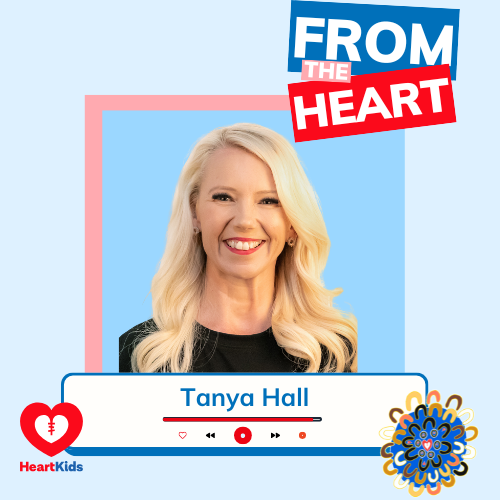
Tanya Hall, CEO and founder of Hearts4heart and member of the World Heart Federation Board, joins us to share how lived experience can reshape care, policy and community. Diagnosed in infancy and navigating a complex journey that includes open heart surgery, arrhythmias, ablations and a pacemaker, Tanya describes the isolation that led her to start Hearts4heart in 2011 and how it has grown into a national organisation supporting, educating and empowering adults with heart conditions.
Transcript:
Sami: Before we begin, we’d like to acknowledge that we are recording on the traditional country of the Kaurna people of the Adelaide Plains. We pay respects to elders past, and present and we pass that respect to any Aboriginal or Torres Strait Islander listeners.
Hello, and welcome to From the Heart. I’m a heart parent, and your host Sami Glastonbury. Today I’m joined by Tanya Hall, the CEO and founder of Hearts4Heart, a national organisation dedicated to supporting, educating, and empowering adults living with heart disease. Tanya is also a strong consumer advocate and someone who lives with heart disease herself. She’s been leading Hearts4Heart since 2011 and was recently elected to the World Heart Federation Board.
Tanya: We all have a voice and I think it’s really important for people to understand, not to underestimate that voice. There are different avenues in which you can be involved and get involved.
I remember speaking to ambulance drivers and cardiologists and nursing staff and literally asking that question like, are there many other people like me my age that are going through this?
I mean, surely I can’t be the only one. And they would all say to me, Tanya, there are so many people.
Sami: Tanya, it’s such a pleasure to have you here with us today. So where are you joining us from?
Tanya: Thank you. Look, it’s an absolute delight to be joining you. Um, I am joining you from Perth, Western Australia.
Sami: Beautiful. Lovely. So for our listeners who may not know a lot about you, Tanya, could you introduce yourself a little bit further than what I’ve sort of mentioned at the beginning?
Tanya: Yes, certainly. So, well, as you say, I am the CEO and founder of Hearts4Heart. We’re a national not-for-profit, and we provide support and education for patients. We run awareness campaigns and we do a lot of advocacy in health policy, but it was through my own lived experience of having a congenital heart disease all of my life that led me to start Hearts4Heart. I had looked for information and support and there wasn’t anything available for people like me. And so I, so I started Hearts4Heart.
Sami: Amazing. And obviously from that drive of, like you said, seeing that gap and understanding that there was probably more people like yourself.
So if you look back, obviously from when you started the organisation in 2011, how has the organisation grown from there?
Tanya: During that time obviously, I was really unwell. I knew that there was this huge need of support and like many people, younger people living with heart disease, it can be very isolating and a lack of awareness.
And so while I knew that there was that lack of support and, and information, I wanted to be involved in the shared decision making of my own health and understand what my future looks like. But I had no idea that we would be doing the work that we were doing now. And I think we as an organisation have just grown organically.
We established at a time where even patient advocacy, it was very early on in the piece. And it was through my experience again, of having to wait for a procedure that wasn’t listed in private health and I was admitted into a hospital weekly whilst waiting for this procedure.
So then that uncovered sort of issues in terms of access, which led me down that path. So we’ve really evolved not only through my own personal experience and understanding the challenges that we have navigating our health system, but also through the community and listening to the patients that we work with.
Sami: Wow. So that’s incredible. And it’s so, like you said, it’s been informed by your own lived experience and as you said, identifying those unmet needs. But I’m sure you must have been the whole time thinking I’m not the only one.
Tanya: I remember speaking to ambulance drivers and cardiologists and nursing staff and literally asking that question like, are there many other people like me my age that are going through this?
I mean, surely I can’t be the only one. And they would all say to me, Tanya, there are so many people. So I thought, okay, then it may be worth me, starting something and to see how we evolve. I started a website and shared information I learned along the way. I also had a background in counselling, so I felt I was in a position to be able to provide that one-on-one sort of peer support.
And so, and again, we evolved from there.
Sami: Yeah, so, uh, and I love the fact that you’ve even just touched on, like, I started a website. I love it how it just starts. It’s like, right, I’m just gonna start. I’m just gonna, I’m just gonna see what happens, see what it flashes out.
But I suppose that’s that really big piece around sharing information and how important it is. You’ve touched on that journey and that informed decision making, but that all starts with awareness and education. So how, if, talk me through what it was like trying to, to start that awareness and education piece out there.
Tanya: I think when you, obviously I wasn’t the only one that recognised that unmet need and so every door that I knocked on opened, the clinicians jumped on board. Other organisations jumped on board. We, I was lucky to have, to be able to lean on others. I think like anything when you wanting to start out, but you don’t know quite how to go about it, it’s always really good to be able to lean on others who have done a similar thing. So I had reached out to other patient organisations in other disease areas who provided me with a lot of guidance. So I think I was really lucky in that sense.
I knew I was onto the right path just because of the fact that everybody was so supportive. They really recognised that there really wasn’t anything available. And so hence why we just evolved from there.
Sami: Yeah, it sounds beautifully organic and, it’d be like Pandora’s box, isn’t it? It’s almost like, I’m sure, like you said, when you knocked on that door next minute, someone else was probably sharing their story or pointing you with in another direction. So what started with, where do I begin to, here we are now.
So do you mind sharing with this Tanya, about your condition and, you mentioned before your first surgery was when you were nine, so can you tell us about your condition and what it was like hearing that diagnosis as a child?
Tanya: Well, for me, I was diagnosed at six months old.
So, I had quarterly visits to my cardiologist right from then. So for me, it’s, all I’ve known all of my life. When I was living in Perth at the time, but we moved to Sydney, because of my, my grandfather was living there at the time and I had my first cardiologist sort of checkup there and they had said I was a very sick little girl.
I had a really big hole in my heart and as I’m sure you know, for a lot of children, sometimes they close up on their own, but mine didn’t. Mine was getting bigger and so I would walk a very short distance and I would turn blue and I was out of breath. And so they had me in theatre very, very quickly.
And so I think partly well because of that and the surgery and part of it is congenital, but I then, I started having arrhythmia problems when I was sort of at around 17 years old, and so, a very long story short I have been, I’ve had experience with, with, SVT, with atrial Flutter, with bradycardia.
So I have a pacemaker, atrial fibrillation. Um, so I’ve had six ablations and a number of cardioversions. So it has been a journey and it’s a lifelong condition, and management. But I am, I’m incredibly lucky in the sense that my experience has led me down a path to do something that I’m really passionate about, and I think through every experience that I personally go through, I learn more and more about the challenges of, of navigating the health system, how else we can grow our community and provide that additional support to others going through a similar experience.
Sami: Tanya, that is so complex. That is incredibly complex and I’m sure many people listening – a lot of our audience is obviously parents that have recently found out that their child has a diagnosis or they’re on the journey or they’re post-op and they’re waiting for the next surgery. Um, and also too, we just have a whole group of, obviously people within, I like to call it our village listening.
But I’m sure that was probably really confronting for people to hear walking along, turning blue. But for us it’s normal, isn’t it? It’s our, it’s our normal in our village and in our community. So how did you, how do you then deal with, because I’m fascinated. I’m fascinated by the fact that you have this incredibly complex medical condition, but you’ve clearly got a drive, which I love, which seems to be very common in our heart community.
A drive to constantly improve. So how do you manage your health condition and still drive and do what you do for Heart4hearts?
Tanya: I think you just never lose a passion, and again I’m in a unique situation where obviously this is a condition I’m going to have for the rest of my life. I’m lucky to be connected and working with incredible stakeholders that are in this field. I hear the stories of patients every day and we connect, like I feel privileged to be part of that community because, not only are we able to provide the support for them. But even in my own, personal circumstances, like my recent surgery, I had a lot of patients reach out to me.
And that was really beautiful because it is, the whole reason why I started it was that feeling of isolation. Isolation and wanting and wanting that education, which we’re obviously now able to provide. But I’m part of a community and again, for many people as part of your community, this is a, for many it will be a lifelong journey, but having that support and being part of that community means everything.
And I think it just, and also having the ability to give back and turn it into something meaningful is a privilege.
Sami: Well said. Well said. I admire you beyond words. I love the fact that yeah, you’re, there’s many people that would, would say, oh, that’s now too much. Or, I’ve had that next procedure.
Or like you’ve just said, you’ve just had a pacemaker. There’s, there’s a lot of people that would probably sit back. It sounds like you get your energy by every single time you know that you are giving back, it’s obviously filling your cup up and filling your tank up to, to keep going, so.
Tanya: Absolutely.
Sami: I’d love to understand also too, you do incredible work in the advocacy and that influence space. At the start of the podcast, we obviously talked about the policy influence that you’ve had. Where do we begin? Where do we begin with that? You obviously said that you’re in the back of an ambulance and you’re asking, Hey, surely I’m not the only one.
Why can’t I find any information? Where do you start? Where do you start with that advocacy and policy?
Tanya: Yeah, it’s a really good question and it’s a complex one. You feel –
Sami: We’re here to listen!
Tanya: I feel that, at an individual level even, we are an advocate for our own health or an advocate for, we may be caring for someone and every patient needs that advocate.
Navigating the health system and, again, that ongoing journey. But in terms of advocating, when I was, one of the cardiologists had said to me, Tanya, we have a problem that we’ve got waiting lists for up to two years, which are now, in some cases it’s four years.
I don’t know if you can call it a waiting list anymore. And we need the patient voice behind it. And I, at that point, I didn’t know where to start. And I had engaged with, and this was many years ago, with a lobbyist who kind of was able to give me some guidance because he too recognised it.
At that point, there was no patient advocacy in the cardiovascular space. So it was really needed and it was also at a time when, again –
Sami: That blows my mind. That blows my mind. You just saying that. And it’s not that long ago.
Tanya: Exactly. And it just so happened to be during a time when also patient advocates were also started advocating in other disease areas, like I said, cancer groups and others.
And so, so I feel like almost collectively that there was a movement. And so initially we thought, okay, well, we’ll start a, we’ll run an awareness event in Parliament, and during that time we’ll meet with politicians and talk to them about the prevalence of the particular condition that we were advocating for.
And then talk to them about, well now there’s a treatment available but we don’t have access because of A, B, and C. And so there was a strategy that we had to put behind that. But bringing that lived experience, I remember one of the cardiologists said, because I always made sure I had, with every meeting I had that I had a cardiologist with me, I could talk to the prevalence and my personal experience and then they could be back it up from their clinical perspective.
And I remembered them saying to me, we’ve been advocating for this for 10 years. And the moment you spoke about your lived experience and brought meaning as is, this is the, this is how you know I was, in and out of hospital, in calling ambulances every week until I had this procedure and overnight I went from not being able to work to getting back into the workforce, living a normal life.
Then the politicians started listening and so, and that’s essentially wha,t you know, I mean, again, there’s a strategy we had behind it, but that essentially that’s why we were able to make change. And so that led us down a path of we are now involved in any, every policy review, we provide input into any new, cardiac device or medicine, if there are any barriers to access.
I get involved, like the heart check cardiac remote monitoring, any cardiac services, anything and everything related to the cardiovascular space. But we all have a voice and I think it’s really important for people to understand, not to underestimate that voice. There are different avenues in which you can be involved and get involved.
We have embarked on an advocacy training academy this year, which I’m really proud of because we wanted to be able to share this knowledge and train others to use their voice in a powerful way and how to be involved in advocacy or in research or in clinical guidelines or even teaching them how to share their story in impactful way.
So it really depends on what each person feels comfortable in doing and in getting involved in. Obviously some are really confident and really happy to speak to media and others are happy just to sit back and provide input into research. So we wanna be able to create, provide that platform so that people can use their voice and, and get involved.
And there are organisations like yours and like ours that can, that can be that catalyst for them to use their voice in a meaningful way.
Sami: Tanya, you are, you are talking my language. I’m absolutely, I’m absolutely fangirling over here. The whole using your voice, patient advocacy, you contributing to better outcomes, feeding into policy.
And I love that you even just chatted about you sitting there beside a cardiologist, but you brought it to life because I think this is the point that I know, I always like to sort of say to people or, you know exactly that. Use your voice or, speak up or let them know or provide that feedback.
As long as you do it in an incredibly respectful way, and you’re coming from a space of love and, and compassion for the greater good.
You brought those numbers to life. If you think about it, they were black and white numbers on a piece of paper. They were statistics that we were kept presenting to parliament and here you are.
You’ve turned up, you’ve got everyone’s attention. Honestly, music to my ears. I love it. I absolutely love it. But in that moment, tell me, what were you feeling? Were you actually going, hang on a minute, I’ve got parliament’s ear, like I’ve got – was that a real moment for you?
Tanya: Absolutely. I think, I mean, it was incredibly nerve-wracking to start off with, but then I would just think, right, put my patient hat on and I am, I think I just approached it, I’m representing the community and the people that we support, and so, when you realise that you are dealing with people, every politician, uh, they’re a person too.
Sami: Person first. That’s right.
Tanya: And yes, there are gonna be some people that are going to be more connected to your calls than others. And so part of that journey is obviously identifying who those people are. But it was an incredible experience for me to see too, just how passionate that they were, that, um, again, that they really wanted to see meaningful change and that they, that many of them are in there really to make a positive impact for people too.
So it was, but I think, but sometimes advocacy takes time. It isn’t something that happens overnight. It’s not, so you need persistence and you need that –
Sami: Grit.
Tanya: Exactly. And you think you’re gonna be knocked back but persistence is key. Being at the table is key.
And when you, and when you finally get there, it’s a huge, it is an incredible feeling. To have had some small role to play in improving outcomes for people living with heart disease.
Sami: I love it. I wish I was there. I wish I was a fly on the wall that day. I really, really do.
Tanya: Lots of tears.
Sami: Yeah, I bet. I bet there was lots of tears. I bet there was lots of goosebumps and lots of moments of, but like you said, I think we sometimes forget this, don’t we? We sometimes put these sort of, these invisible barriers, don’t we, around things like whether it be advocacy politicians, whether it be around clinicians and different parts of that stakeholder piece.
But it’s really a powerful message that you’re sharing here, it has to be collective for it to work. It has to be a collaboration and no lens is right or wrong. It’s just a lens that feeds into this, feeds into this piece. So what, for people sort of listening, there’d be people that were probably, processing everything you’ve just said.
So here you are, you’ve lived with this all your life. You are advocating for yourself daily, to get the best healthcare. You then said I’m starting a website, I’m gonna start sharing this information because I can’t find it. So I’m just gonna start asking around and, and learning. I love the fact that you’ve learnt from other organisations because we are crazy to think that we have to reinvent the wheel.
There’s a lot of resources out there that we should just be just sharing collectively.
Tanya: Yeah.
Sami: Next minute you’re in parliament. Next minute you’ve got a stakeholder beside you and a cardiologist going, hang on a minute, I’ve had this conversation 10 times over and didn’t get the reaction you did. So there’d be people listening, going, okay, so you are one person, you’re one voice.
How on earth did you impact policy and what does that look like?
Tanya: Look yes, I was one person, but it absolutely took collaboration, and collaboration is key I think for us, collectively moving forward. I think, we’ve heard the cancer groups have been incredible with public awareness, with advocacy, with funding into research, with funding into everything, and I feel that now we’re moving into a space where, as we are all collaborating a lot more effectively in our sector, right? So, we can’t do it on our own. So I can’t take full credit for this. We, you need to be working with the clinical societies.
You need to be working with government. You need to be working withindustry at times. It has to be a collaboration of all stakeholders who have a unified voice. And again, it’s just having that strategy. But, for, like I said, for us as an organisation, it’s working with organisations like yours and, and others.
Uh, the Heart Foundation are doing incredible work and are being incredibly supportive and collaborative with both of our organisations.
Sami: Absolutely.
Tanya: And with the likes of other research organisations, Victor Chang and so forth. So I feel that, it is essential that this collaboration continues and I think that’s the only way that we’ll continue to make change.
Sami: Yeah. No, no. Well said. And I think we have seen that change.
Tanya: Yes.
Sami: It’s funny, isn’t it? It’s almost like it’s that path. Um, and then you work out, hang on a minute, that we don’t have to be, we don’t have to be doing the hard slog. We can jump and walk alongside and share the path. Um, because we’re all here for the same outcome. Let’s face it. We’re all here for it.
I’d love to shift the conversation. Obviously we’ve talked around what things look like in Australia. This, again, I’m gonna have a bit of a fangirl moment. But you’ve recently been elected to the World Heart Federation board.
So let’s break that down for people listening. So this is, now we’re talking global. So you are representing our community on a global scale. So what does that look like and is that another moment where you went, hang on a minute. How did, how did I get here?
Tanya: Absolutely. I still feel that, because look, I think even with the clinical societies for a very long time, I think there was, perhaps they didn’t quite realise the importance of the patient voice and that applies to government too. I think but now as, as I’ve mentioned, things have changed. They’re realising the importance of us, our voice and health policy.
Because and in all areas in research, none of it really matters unless, I mean, it’s for us. So without our voice and without understanding the meaning and how it, the impact and if it’s actually implementable, what’s the point? Right? And so the World Heart Federation, I’m incredibly honoured to be involved in that.
It’s the first time they’ve ever had patient representation on the board, and it’s really, kudos to them for leading the way in that. And so we’re exploring ways in which we can further integrate the patient voice and the lived experience and voice into other areas, into, the various committees and projects within the World Heart Federation.
But it is essential. I mean, it, equity obviously, is absolutely front and centre for me. In Australia to some degree, we’re lucky to have access to healthcare, but it does depend on where you live, your postcode, and at times, you know whether or not you have private healthcare or not, so that division, I think of equity is becoming greater and it’s even more so globally. So, that is certainly a very big passion of mine and for us to collectively work together on. And it’s complex and, different. While there are similarities in to some degree with, with various, countries across the globe, there are also…We are living in a very privileged country where there are others that are not so fortunate. So I am again, very privileged to be involved from that perspective and advocate in those areas but also to bring that lived experience to the table.
Sami: And so now that you’ve got, you’ve got that incredible position, and I’m sure from even just how you’ve spoken and shared, you clearly don’t take that lightly. So when you bring that level of perspective, how’s it received, how’s it received when you’re sitting around that table?
Tanya: They’ve all been incredibly supportive.
And we’re all aligned, again I think we all want to see timely access to diagnosis, treatments, so forth. They, again, they really recognise the need, but they also see the influence that we have now. It’s changed over time. They now know that patient organisations and patient advocates really make change. We’re the voter’s voice. And so, we are incredibly influential in health policy. And so I feel respected, I feel heard, they really do take on my recommendations and are very keen to explore how well they can work with patient organisations, moving forward. So it’s a great opportunity and I, and again, I, because I do feel even in Australia at times, there’s still a little bit of the old school way of thinking that there’s the angry patient that is jumping up and down and advocating.
Whereas, we bring so much more to the table and hence why even with the patient training Academy, we really wanna be able to give that experience to patients so they know how to engage in a productive and informed way. They have very strong and powerful and meaningful stories to tell, but how do we translate that into meaningful input into research and health policy and other things.
Again, it’s been a great privilege. And we also work with other – I sit on a few councils at the Global Heart Hub which is an incredible organisation that bring patient organisations together from across the globe. And so they, so we are working very closely together and again, it’s now sort of almost a movement in the cardiovascular space.
So there’s a lot of work that we are doing globally. And, you mentioned earlier, there’s no point in reinventing the wheel. And I think this is what that community is all about. There are some that are much more advanced than others. Some that are just starting out.
So we’re really there to lean on each other and lift each other up and support each other and provide resources and, and, and support wherever we can.
Sami: Yeah, and that’s the first thing that leads to in my mind is so where do we sit, Tanya? Like, where do we sit globally? Like, how are we sitting in Australia in that respect of where we are with that equity piece?
Don’t get me wrong, I understand we’re a privileged country, but, I don’t know. I suppose we are very isolated on this big island of ours, and so you kind of wonder like, how are they doing it in America and how are they doing it in different parts of Europe and Asia and so forth. So where do we sit kind of in that equity space in Australia?
That is, and where do we also to sit in that patient advocacy? I know you said you know that we’re slightly, we’re still, there’s a couple of things, a couple of boulders, we need to just sort of move out of the way. But yeah, I’d be really curious to know.
Tanya: Look, in terms of patient advocacy, we are most definitely the more, more advanced in other countries really, even in the health technology as assessment. So we’ll often refer to as HTA, I think we’re the only ones involved in HTA. Well this is sort of going back a little bit now. There’s much more involvement in the cardiovascular space.
So I think, and in terms of even meaningful engagement, we are certainly much more advanced and government are much more receptive in engaging with us. Which is a huge positive. We still have barriers.
Sami: Of course.
Tanya: And we are still, there’s a HDA reform taking place now and obviously we are collectively advocating for, the recommendations that have been put forward to ensure that that’s embedded, that patient engagement is embedded. But you know, but look, we have our barriers, right? Even though we’re seen as a wealthy country. I mean, we still have significant issues, in terms of access, particularly in our rural and regional areas, right?
So, there is that misconception. I think that, we’re a wealthy country, that we have, everyone has access, but that is not the case and we still have a lot of work to do.
Sami: We definitely, we definitely do. But that’s, yeah, that’s not surprising. I’m not gonna say I’m surprised, I suppose I just didn’t have a level of awareness of where we sort of sat on that global sphere when it came to patient advocacy and that informed care, I suppose.
I’m just thinking of sort of my knowledge of Planetree Accreditation and obviously we have one paediatric hospital in Australia that has it, which is the Brisbane Children’s Hospital. And we are going for accreditation down here in South Australia. So we will be only the second with Planetree Accreditation in the Southern Hemisphere, which is, and that’s all around that informed patient journey.
And ensuring that in the room that conversation is happening with a clinician, that the patient is well informed and a part of their health outcome. So yeah, fascinating to understand. So what are some of the lessons that you’ve, that you sort of take away from that global piece, and what do you think that there’s something that we can apply here in Australia that you’ve learnt?
Tanya: Look, I just think that I’ll refer back to that, don’t underestimate the patient voice, and I think it’s exciting to see that growing globally. I think, again, as I mentioned, we all experience similar challenges and similar journeys as patients, but it’s just that the healthcare systems can vary.
Sami: Mm-hmm.
Tanya: So I think, I just see that there is, again, there’s a movement and globally, and I think that we just need to be sure that we have a seat at the table, at every stage of the process, right? From, again, clinical trials through to research, health policy even as individuals and, and shared decision making.
But I think it’s just there’s that synergy across no matter where you live that we’re experiencing. The same things and wanting and needing the same things, if that makes sense.
Sami: No, no, no. It does. It does. It makes complete sense. And I think that probably sort of leads us into my next question is around like where do you see the future going?
And it sounds like you’re saying, look, everyone’s jumping on the bus, but we’re just gonna make sure that we keep our seats and we’re on every bus.
Tanya: Yeah, absolutely. And I, and again, I see that growing collaboration across sectors, and there’s a real recognition of the importance of patient voices is essentially it, and, we can’t do it on our own. And so, and we all have a role to play, and it may be a different role, but it’s all important. And so we just can’t tackle this on our own. So I think that, I’m excited at, I mean, even in the short time that I’ve been doing this since 2011, there’s been a massive shift.
And so I think, and it’s exciting to see that just build momentum. And so we just need to continue on that path.
Sami: No, no, no. Absolutely. Well, we’re right there with you. I can tell you, I can tell you that much. We’re a group, we’re a group of equally passionate, um, people about this space as everyone at HeartKids.
But like you said, it’s such a collective now. Um, and that wasn’t the case. I know. I’ve only been around, um, I’m a heart mum and I’ve only been around since my son was born, so 11 years. But I’ve seen a shift, I’ve seen a shift in the access to information. Like you said, when like you were saying, like, hang on a minute.
I can’t be the only one. They were exactly the thoughts that ran through my head when I left RCH and the thought, I can’t be the first mum, and I know I’m not gonna be the last mum. So we need to make sure that we’re informing, we’re informing along the journey. And I’m so proud of where HeartKids has come and the fact that we’ve got so many factsheets and information available like you, like, the fact that you’re informing, informing sort of policy, like that’s for every, every heart kid.
That’s for every heart adult, that’s for anyone, who lives with a heart condition.
Tanya: Yeah.
Sami: Doesn’t matter. Every step we take, it’s for that next person.
Tanya: Absolutely. And, and our, like you, we’ve developed a number of resources in a patient friendly language so that it can support them not only through their journey, but to make shared decision making, like with their clinician on their journey. I mean, it’s our life and so it’s important that we’re informed. It helps, we know that it improves clinical outcomes it is really important that we’re, not only do we have that support, but we have that education to be able to support us through the journey and that peer support, right?
So that we’re not alone. And it’s funny, I mean, I’ve also been a massive fan and supporter of HeartKids way back when. I mean, I remember when I very first started Hearts4Heart and I worked quite closely with HeartKids then. And even just the transition from children into adult hospitals right is a massive, it’s a huge change. And so we were running events together, once a year for those kids that were being transitioned from children into adult hospitals to try and give them some guidance and tips to help them through that transition because it is a big change.
And that’s the thing, it is an ongoing journey. And even for me, as I said earlier, each time I have a new challenge, or it is readjusting to the new norm. And, um, and it’s a journey, but it’s a journey that we’re not on alone. And I think that’s what’s really important for the, for our community.
Sami: And I think you’ve just answered my next question is if, if someone’s listening to this podcast. What do you want them to, because I know that different people we’ve interviewed over the time Tanya, which I’m sure you’d appreciate and be the same with the conversations you have, is it’s that resounding theme.
I feel isolated. I felt alone or I felt invisible, or whatever it is. So what do you share? What do you share with someone when you, when you’re confronted with that expression?
Tanya: Exactly that. That you know you’re not alone. And we all do feel that. And we also all go through this very similar emotions, and I’m sure as a mum, you’d be able to relate to many other parents. For us as patients, we can relate to each other. We know, there’s so many, there’s so many different emotions at different times that you feel, leading up to procedures or when you get a new diagnosis.
Or when you are, there again, navigating the health system and some of us live with multiple conditions, which can be complex, to navigate. So, so it is exactly that, it does feel isolating and it is complex, but you’re not alone. And we all, so many of us go through those same complexities and challenges and we’re just here to support you through that journey.
Sami: Yeah. It’s for us all to come together, lean in, support each other. Yeah. Have those conversations. So, Tanya, looking ahead, what is your vision for patient led advocacy over the next decade? If you had to write this script.
Tanya: Oh gosh. I mean, if I could write the script, I mean, really I would love, there needs to be more awareness about this.
There needs, there are so many preventable cardiovascular deaths. I mean, I would just love there to be much more education about it. My own father died of undiagnosed heart failure at the age of 59. And I had a friend pass away last week actually from undiagnosed heart failure.
So it’s very raw and real for me. But I just think no matter, I just feel that there’s just still that element of even younger people just not, who haven’t been diagnosed, aren’t taking it as seriously as well as they should, our heart health. And so, I just, that needle needs to shift.
We need to shift the dial. But obviously I wanna see more patient representation in every level of healthcare, which obviously again, it’s something we’ve been advocating for and we’re certainly seeing more of, but we need to be seen as equal stakeholders. Not as, to be consulted but as equal stakeholders in the healthcare journey.
Sami: No, beautifully said. Like you said, we need to be, not just sitting around the table. We need to be contributing and we need to be there from the start to the very end. Absolutely. Well, Tanya, honestly, I have enjoyed this conversation so much, so so much, and I feel that I could probably talk to you for hours because I have so many questions.
But I know that you’re incredibly busy and we’re incredibly grateful for your time. But I do think we are gonna have to lock in episode number two.
Tanya: Always happy. I appreciate the work you do, so I am always here to support you.
Sami: No, and thank you. Thank you for flying the flag. Thank you from every single heart parent, heart kid, anyone with heart conditions or anything heart related.
Thank you for flying the flag for us globally.
Tanya: Thank you. Thank you. I really appreciate that. Thank you.
Sami: Sometimes this podcast talks about some heavy things.
If this brings up anything for you or someone you love, it is important to reach out for support. The HeartKids Helpline provides support and guidance for anyone impacted by CoHD. You can call the helpline on 1800 432 785. To access more information as well as support from Heart Kids, visit the website at heartkids.org au.
The information on this podcast is not a substitute for medical advice from your doctor or healthcare team. Always talk to your doctor about matters that affect you or your family’s health.